A Gothic Identity Crisis

My mom doesn’t like Goths. Not that she’s ever really known one. But she seemed confused and displeased when I first told her my trilogy was rooted in the conflict between the Goths and Rome. I know I have really well-informed readers here, but on the remote chance you share her confusion (or displeasure), I thought I’d clear a few things up—as I tried to do for Mom. Hopefully, confused or not, you’ll find it interesting.

A Tale of Two Goths: Turns out my mom’s confusion was what led to her displeasure. I was talking about the Germanic Tribe of the Goths, and their cultural and sometimes violent clashes with the civilized world, represented at the time (during the first five or so centuries AD) by the Roman Empire. Meanwhile, my mom had conjured images of pasty-faced youths with blue lipstick and multiple body piercings, rolling out of bed at midday after a night of crazed dancing to industrial techno music to voice their opposition to the Roman Catholic Church.

I wrote an article for the homepage of my website called The Origin of Epic. In it, I reveal that my interest in the Goths began early, when I read that Tolkien’s Riders of Rohan were based on the Goths. When my school history courses covered the fall of the Roman Empire, the Goths, being the first to sack the city of Rome, were always among the featured antagonists. The seemingly divergent viewpoints (cool horse-warrior good guys vs. evil horde that helps to extinguish the light of the civilized world) led to an ongoing curiosity.

So when I mention the Goths, I’m thinking of Éomer son of Éomund, bearer of the sword Guthwine. Mom, on the other hand, is thinking more along the lines of Edward, wielder of Scissorhands.

Roman Disdain/Admiration: One of the challenges I faced in featuring the Goths in my story was the lack of literary sources. Although roughly the same percentage of Goths were literate as Roman citizens (around 15%), alas the Goths left few surviving writings. The writings of Romans such as Tacitus and Marcellinus demonstrate a sort of love/hate fascination with the Germanics generally and the Goths particularly. Tacitus says they “…all have fierce blue eyes, long red or yellow hair, and huge frames apt for sudden exertion.”  Grave site analysis has borne him out on their size. Goth males were, on average, four inches taller than their Roman soldier counterparts. And as for the red or yellow hair, it was greatly admired back in the homeland’s cities. Blond wigs and hair dyes were all the rage in imperial Roman high society.

Although Roman authors speak admiringly of the Goths’ physical beauty, battlefield fierceness and valor, and chaste marital bonds, they also speak of their impulsiveness, lack of capacity for reason, and proclivity to sloth, drink, and gambling. Hmm, that last part sounds a bit like… just about every powerful group of humans speaking of their foe.
Goth as Pejorative: So I explained all this to Mom, and she was still confused. “If that’s true,” she wondered, “why then do these young goth kids whiten their faces, darken their lips, and blacken their hair?”

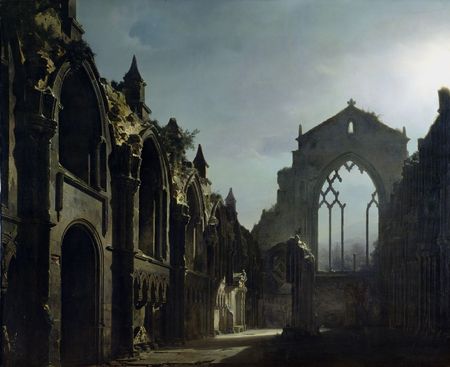
The answer, as it so often does, lies in literature—or, in this case, in a literary movement. But in order to understand the origin of Gothic literature, we’ve got to take a quick look at Gothic architecture. Gothic describes the architectural style of the middle to late medieval period. But the term was attached to the previous era’s style by the new architects of the Renaissance. They meant it as a pejorative—archaic, outmoded, severe and ungainly.

It’s Alive! By most accounts, the Gothic movement in literature started with a single book: Horace Walpole’s The Castle of Otranto: A Gothic Story (1765). Contemporary readers were enthralled by the book’s suspenseful weaving of the medieval setting and the supernatural trappings of the plot. So much so that the book instantly spawned hosts of imitators. And so a thriving genre was born, and Europe’s aging and ungainly gothic castles, manor houses, and monasteries became the setting for ghosts, monsters and the undead. Flash forward a couple hundred years, and fans of the creepiness still dress to suit the macabre underpinnings Walpole established. These fans are my mom’s preconceived Goths.

When Goths Were Still Cool: In 451, as the western Roman Empire slowly crumbled and at the urging of Emperor Valentinian III, a confederation led by the Visigoth king, Theodoric I, defeated Attila the Hun and his Vandal allies at Chalons, France. The Gothic kings had become central to the inner workings of empire. I mention this because, however you heard it in history class, the empire did not fall when Rome was sacked by the Goths under Alaric in 410 (also, did you know Alaric considered himself a member of the imperial military, and marched on Rome to demand his rightful status and pay for his men after fighting to defeat a Frankish usurper at the Battle of the Frigidus?).

Kings of a Score of Kingdoms for a Thousand Years: In tribute for their service to a failing empire, the Visigoth kings were ceded large tracts of imperial territory in Spain, southern France, and southwestern Germany. Shortly thereafter, the Ostrogoth Kings of the east were grabbing territory on the Italian peninsula and in the Balkans. For many centuries, the Spanish nobility self-identified by laying claim to being of the blood of the Goths. Because the Goths supposedly originated in Götaland, Sweden, until 1973 that nation’s monarch’s title was King of the Swedes, the Goths and the Vends.

At the Papal Council of Basel in 1434, the Spanish and Swedish delegations of cardinals clashed over the rights to sit closest to the Papal seat. It’s said the Swedes argued that since their forefathers founded all of the Visigoth and Ostrogoth kingdoms, they should sit closest to the holy seat. The Spanish delegation supposedly retorted that only the lazy and unadventurous Goths remained in Sweden while the heroic Goths conquered an empire and established their highest seat in Spain.

I’m pretty sure my mom’s preconceived Goths would never vie for such a spot.

Éomer of the Riddermark or Dracula of Transylvania? So what’s your first thought when you hear the word Goth? How ‘bout your mom? Do you think Goths will ever be cool again, or did I pick a (twice) doomed subject?
Appreciation for Betas (or Readers Rock!)

Question: If a book falls in the forest and no one’s there to read it, does it still stink?

Answer: Most likely.

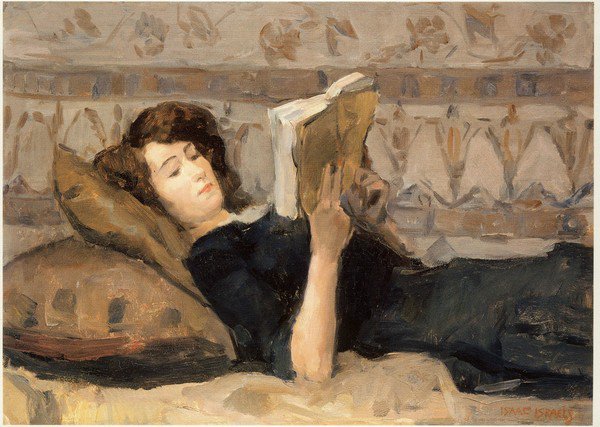
Reading Girl on a Sofa, by Isaac Israels (1920)

Perverse Process: I know I’ve been lucky. I’ve had fantastic beta-readers throughout my journey. Not everyone has such good fortune. In my role as a moderator for the Writer Unboxed online community, I see it often. Writers are looking for readers. For what is a story without someone to tell it to? The problems come when writers seek said readers too early. No reader deserves to slog through first draft material. And let’s face it, early drafts typically suck. And yet novice writers almost always subject some poor undeserving reader (usually a close friend or a relative) to work that’s not ready to be shown. It’s part of the process. I did it too.

How those early readers of your amateur drivel handle their role can be critical, especially if the writer is sensitive, emotional or has a fragile ego. Feel free to laugh. Of course it’s a joke. (For those who aren’t writers and didn’t get it: We’re ALL sensitive, emotional, fragile souls—why else would we spend most of our waking hours exploring the emotions of people we’ve made up and then hope that others will connect with what we’ve found?)

Honesty Ain’t Easy: I said I’ve been lucky and this includes my draw of early beta-readers. When I finished my first draft, I didn’t belong to any critique groups and I didn’t really know any other writers. And yet some friends and family kindly offered to forge into the murk. A few gave up. A few avoided me afterward. A few pretended it had never happened (“Manuscript? What manuscript?”). But several brave souls either made it through or had the courage to tell me they’d stopped reading and why. To the reader, those who made it through were kind and insightful in telling me it needed work. But more importantly they also showed me there was promise. I continued to work because they kindled hope. It was a special gift.

B-Company Betas: Over the course of seeking a second round of betas, I had no idea how much farther I had to go, and for that I am grateful. After learning there was work to be done, I set about studying the craft and I joined an online writing community. Then I tackled revisions. I did fare much better with the next round of betas (as did they—the work was evidently and necessarily much more palatable). I learned from the first group that I might actually have something. From this next group I started to gain some insight into genuine reader expectations, as well as a bit of traction and enthusiasm for continuing to work (rather than just hoping everyone would say they loved it). I learned something unique from each reader in Company B. They were critical not just to moving forward, but to knowing I could improve it and being excited about it.

Brass Tacks Betas: I’ve written about how fortunate I feel to have connected with my editor/mentor Cathy over on WU (read it here if you haven’t). Because of Cathy and my evolution as a writer, the books all underwent significant revision before this next group of betas, particularly book one. Now we were starting to make them into what felt more like real books. Among the next wave of readers to hit the beaches were my writer friends. Now I was getting real critique (of the variety many of you receive in critique groups as you move along). Telling rather than showing, poor grammar mechanics, adverbs in dialog tags, and just plain clunky writing were all noted and polished.

Right Reader Revelations: After the Brass Tacks round of readers, I did another total rewrite and went into submissions for the second time. Throughout the process I’d been zeroing in on my Right Reader, and providentially I found several readers at this point to fit the bill (females—often younger/new adult females—who are voracious readers and favor epics with romantic elements). Now I felt like I was swinging for the fences. Although the submissions did not yield an agent, I did get a few requests for pages and some encouraging feedback. So no home run. However, the feedback I was receiving from the Right Reader betas made it clear I was solidly connecting with the ball. I felt more certain than ever that this was a story that would find an audience.

Inspirational Beta: One of the Right Reader betas actually inspired this post. She’s an acquaintance I see a few times per year. Several months ago we got to talking at a party about our mutual love of Hunger Games and George RR Martin and she asked if she could read. I sent her book one, but rarely saw her afterward and only in mixed company. All I really knew was that after each of the first two books, she requested the next. What more could I ask? I just ran into her the other night at a chamber of commerce meeting. During the keynote presentation she saw me outside the dining hall at the bar (where else?). Her smile would’ve been enough, but she ran over and gave me a hug, and gave me one of the nicest compliments I’ve ever received: “I can’t wait until these books are popular so I can tell everyone I read them first.” I’m still smiling about it.

Let a Beta Be: If you’ve never used beta readers before, a bit of advice (besides striving to offer them work that’s ready to be read). Offer as few guidelines as possible. I usually say something like, “Just read it for flow and for feedback I’ll happily take whatever you’re comfortable giving, even general feelings.” Every beta reader I’ve had has given me something different.

I’ve had betas point out plot inconsistencies, help me change a few names, offer suggestion to keep elements in greater suspense. Betas have helped me make my MCs more likeable and my antagonists more despicable. I’ve even had a former teacher who did a complete line edit of the entire trilogy, meticulously marking and noting every single typo and grammar error (thanks Aunt Cindy!). A few have mostly offered enthusiastic encouragement—which is vitally important, believe me!

The Road Goes (Ever?) On: I’m not sure what will happen with the trilogy, but I am absolutely certain the books are vastly improved and that they continue to be a viable possibility because of my beta readers. I’m thinking most have honestly enjoyed being a part of the process. I’ve been amazed by the uniqueness of their perspectives and I love the process of distilling their various opinions to plot a course forward. I dare say a few of the earliest readers would be a bit shocked by what the books have become.

Couldn’t Builda Betta’ Beta Team: In the interest of personally and publicly showing my gratitude, here is a list of my fabulous Team Beta (I hope I haven’t forgotten anyone—forgive me if I have!): Dan Brake, Marsha Carroll, Tawn Horton, and Amy Murray (Early Readers); Cindy Deane, Jenn Gardner,  and Colleen Murray (B-Company readers); Kim Bullock, Valerie Chandler, and Heather Reid (my Brass Tacks/Writer Team, aka The WU Mod Squad); Keaghan Cronin, Laura Kieda, Eileen Kochanny, and Deb Wagner (Team Right Reader). And last but oh-so-importantly, my lovely wife Maureen Donnelly Culp, who inspires and supports me every day, and without whom the trilogy would not exist.

I cannot thank you all enough for your gift. Whatever comes of the trilogy, you have not only helped to improve my manuscripts, you’ve made me a better writer and have brightened my life.

Your turn. Have you been a beta reader or had beta readers for your work? How has it affected you?

The Grittiness Factor

gritty [ˈgrɪtɪ] adj -tier, -tiest

1. courageous; hardy; resolute

2. of, like, or containing grit

The definition of the word gritty is pretty straightforward. But for the sake of this post, let me also share one of The Urban Dictionary’s definitions. It’s perhaps more fitting for this post, sarcasm and all:

Gritty—a type of realism, usually invoked by films and documentary (author’s note:and books!). Strangely enough, “gritty realism” is only perceptible to media critics and the term is hardly ever used by anyone else. In fact, no one but a media critic would ever use the term. Example: “The gritty realism of this documentary is in stark contrast to his other work.”

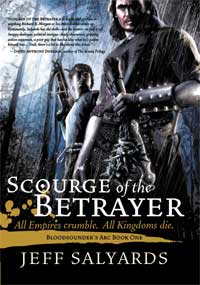
For today’s purposes, I’d prefer to think of myself more as a fantasy fan and an interested observer than an actual critic. I was prompted to the topic by reading, and loving, Scourge of the Betrayer, by Jeff Salyards. I’ve gotten to know Jeff a little through facebook and his blog posts, and found him to be clever, funny, and supportive. He seems like a guy I’d enjoy throwing back a few beers with, maybe whilst taking in a Chicago sporting event. You know, a real guy’s guy. I’m sure I’d get over my writerly envy of his masterful action sequences and  authentic-and-yet-archaic dialog by the bottom of the first round or the end of the first sporting quarter, whichever came first.

Gritty Aspirations: There has been a move in historical fantasy toward (for lack of a better word) grittiness. Before I started writing, I enjoyed gritty historical fiction from authors like Steven Pressfield and Bernard Cornwell, and I also read quite a bit of war-related nonfiction. I aspired to bringing a realistic, non-glorified warrior ethos to my favorite genre of epic fantasy.

It may seem strange, but it wasn’t until after I started writing that I became aware of writers like George RR Martin, Joe Abercrombie, and Glen Cook. And reading these guys made me realized I was hopelessly outmatched.

True Grit: I’m not just talking about a realistic portrayal of battle or violence, though that’s a part of it. Much of the Gritty Movement in historical fantasy has to do with the deconstruction of the genre’s moralistic trope, the simplistic delineation of good versus evil. Characters often have less than pure intentions and motivations. There are often serious and unexpected consequences for actions taken, even if they are taken with the best of intentions. In some cases, with some characters, the worldview digresses darn near to nihilism.

Shades of Gray: I was shooting for this kind of complexity in my own work. And to some degree, I think I’ve achieved it. The world I created is not morally or ethically black and white. Each of my characters believes he is acting for the greater good, even when they are aware their actions may not be considered virtuous. Often there is self-deluding justification involved, but I’m hoping the characters and actions readers might find despicable will also be plausible and maybe even relatable, rather than just evil. And I believe I’ve created real consequences as well. When swords swing and arrows fly, people bleed and, in some cases, die. There is pain and grief and vengefulness and jealousy.

And yet, when my work hits the market, I’m pretty sure few will use the g-word to describe it.

I’m a fan! As I said, the reader in me loves the Gritty Movement. As is the case in Scourge of the Betrayer, Gritty Movement characters are not always self-serving nihilists. They are sometimes motivated by tarnished versions of honor and friendship, often viewed from a jaded perspective. I enjoy seeing these noble glimmers emerging from the gritty characters in my fantasy reading.

Romantic Sentimentalist: My enjoyment of Jeff’s book led to my examination of what keeps my work from achieving true grit. I decided it comes down to a certain kind of sentimentalism. I guess my own romantic notions have made their way onto the page. In spite of the occasional moral ambiguity of their means, my characters are often motivated by idealistic goals. I left much of the tarnish off of their sense of honor. Worse yet, my characters are often motivated by romantic love (something I’ve very rarely seen in the Gritty Movement).

And I’ve decided I’m okay with it. I can incorporate the elements of gritty that enhance my style, and just be a fan of those who’ve mastered true grit, like Mr. Salyards and company.

What about you? Have you actually used the word gritty to describe a book or a movie? Do you like or dislike grittiness, or just accept it as it comes if it works? Can grittiness and romantic sentiment work side by side?

The Mentor/Mentee Benefit—Writer Unboxed Redirect

I’m excited today for two reasons. First, I have the honor to be guest-posting at Writer Unboxed. WU is not just my favorite writing blog, hosting some of my favorite bloggers as regular contributors, it’s the home-base of my tribe. If you haven’t already heard the tale of how I found WU, became involved, and what it means to me, take a look at my first post there, Community—What’s In It For Me.

The second reason I’m excited is the topic of today’s WU post. This article gives me a chance to share one of my greatest writing assets: my mentor and editor extraordinaire, Cathy Yardley of Rock Your Writing. So don’t waste any more time over here. Go read all about it on WU. Go on, scoot! More posts to come here soon. See you here then.

Carving My Niche

My Hue & Cry: Many of you reading have come to know me as a member of your online writing community. I’ve often written about how important community has become to my writing journey. I’m not afraid to use the word tribe when describing those I’ve connected with in the writing world. I don’t know quite where I’d be without the help and support of my tribe. Last week I struggled, and admitted to it in this space. The outpouring I received in response to my call was astonishing and humbling. It made me realize not only how much I’ve grown to enjoy this form of communication but how nourishing it is to my life as an artist. In our tribe, we take care of our own.  
Orange Appled: Even with my new appreciation for blogging, questions linger. One of the reasons I resisted blogging for so long was my belief that writers’ blogs had very little to do with cultivating a reading audience or finding one’s Right Readers. I felt as though the two—my future readers and my writing community—were a bit like apples and oranges: both desirable but entirely different. This seemed particularly true because my genre, historical fantasy, and my tribe’s primary home base, Writer Unboxed, seemed to have little in common. But it seems like the distinction is blurring over time. I’ve met more fantasy writers in WU than I would’ve dreamed possible two years ago, primarily though the WU facebook group.

Hitherto: While I was writing my trilogy, I had absolutely no idea who would read it—who my Right Readers might end up being. It might not be fair or wise, but I’ll admit I consider it a point of pride that I didn’t try to gauge the marketplace while I wrote it. I’m not knocking those who can find the pulse of the market and then tap into their creativity to serve it. But I don’t think the approach would work for me. For me a writing project has to start with passion, and I rarely feel passionate about anything in mainstream culture. I can’t recall the last bestseller I read or the last time I bought any music from a popular top twenty list, and I very rarely go to movies. But I know I’m not alone in the things I love.

An Elan: (élannoun \ā-ˈläⁿ\ Ardor inspired by passion or enthusiasm.) One of the amazing things about the internet is its diversity. It may sound bass-ackward,  but I believe that very diversity can actually be a unifying force. David Byrne of the Talking Heads recently commented on the fragmentation of music through the diversity of satellite radio and the internet. He said, “It makes you a member of a tribe. And your taste in music ties you all together. That need is almost more important than the music itself.”   

In almost any artistic niche, one can become a member of a community. Through shared passion tribes are born. Just as with my tribe (we are all passionate about our writing), so too are there tribes built around epic fantasy, midcentury modern décor, and Lady Gaga, to name three of a million-plus unifying passions. Having an élan can be delicious, but sharing it only makes it all the more enchanting. And today any élan, no matter how unique, can be a shared experience.   

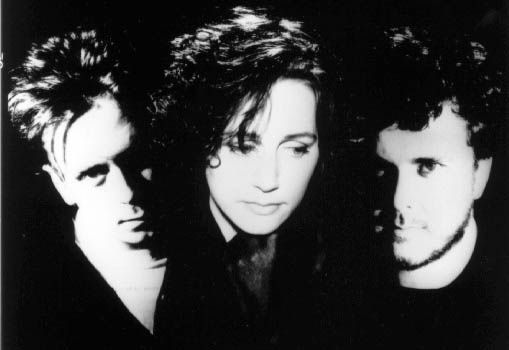
Seekers Who Are Lovers: For the sake of illustration, I’ll share one of my musical élans. I love The Cocteau Twins. I clearly remember the first time I heard their music playing in a funky little college record store (remember record stores?) in the late 80’s. It was instant attraction, but it only grew. In subsequent years, I sought out and bought all of their previous releases, most at import pricing, and instantly snatched up everything they did thereafter. Before the internet, finding rare cuts and import EPs was not so easy. All through those years I didn’t know another soul who felt that kind of passion for them. Their music is not an easily acquired taste (although over the years my wife has grown fond of them, thank God!). In fact, I know several people who dislike them. But it never mattered much to me. I love everything about them, from their overdubbed echo-laden ethereal sound to their unintelligible lyrics to their otherworldly album artwork. Heck, I even love their song titles. [Side-note: Each of this post’s subheadings is a Cocteau Twins song title.]

Treasure Hiding: At some point in my early days of internet browsing, I decided to search The Cocteau Twins, and (you guessed it) to my amazement, there is a large and thriving international community of ardent CT fans–to this day. They even have an annual festival in the UK (in spite of the CTs  having disbanded in 1996). There are remixes and rare cuts shared, and fan forums, and hundreds of videos, and so on. I don’t participate much, but the Cocteau Twins community makes me feel less alone and my élan  all the more enchanting. With the advent of the internet, treasures I once had to search out are now hiding in plain sight.

Atlas Dies Laughing: Back to writing. I mentioned my lacking when it came to preconceiving who might read my work. It’s actually worse than most of you know. I always enjoyed reading fantasy that featured elaborate world-building. So naturally, I built a fairly elaborate world for mine. But in the pursuit of my own passions and interests, I did things fairly uniquely.

For example, I’m not particularly fond of dragons, or any kind of intelligent non-humans for that matter. So I didn’t include any. Also, I am often put off by systems of magic in fantasy. They can feel like a cheap way for the hero to gain the upper hand. So I have no magic. I’ve also long felt that fantasy series with an overt delineation between good and evil were too simplistic. The real world is complicated. There is no black and white, only shades of gray. So I created antagonists with complexity and what I hope are relatable motivations. They believe they’re doing the right thing. They think they’re the good guys!

Turns out the joke’s on me. To many readers, all of these elements I neglected or rejected are the de facto definition of epic historical fantasy. The elaborate world I built fits into almost no one’s preconception of the genre I selected to explore.  

But I’m Not: I understand I won’t convert fantasy readers who expect dragons or elfin magic. And a large portion of the established epic fantasy community might reject the strong elements of romance in my work. But I’ve come to see my work’s uniqueness as a potential strength rather than a weakness. I don’t need to conform to anyone’s preconceptions regarding genre. I never had even the tiniest hope that the trilogy would be a bestseller. But those who do like a bit of romance for the MCs and complexity in their antagonists, and who aren’t so enamored of magic or dragons, might be all the more ardent about my work.

Cathy Yardley recently wrote a post I love called The Slow Writing Movement. Do yourself a favor and go read it. In it, she says, “I believe that writing means connecting with readers. I think that it’s important to know who you’re writing for. I think that this audience should be larger than simply yourself, although I think it can be considerably smaller than most would have you believe.”

I’m still striving toward figuring out exactly who I’ve been writing for, but I’m starting to get a handle on it. With the help of my beta readers, Cathy, and my tribe, I’ve come to believe a niche of Right Readers exists, that it can be more easily cultivated than ever before, and that it’ll be large enough.

Grail Overfloweth: I harbor no illusions that the readers of this blog will be the readers of my books, nor even a significant portion of you. I’m sure a few of you might read, and even enjoy them, but still not be my Right Readers, and that’s all good. After all, just because someone might occasionally enjoy hearing a Cocteau Twins song, it doesn’t mean they’ll start collecting albums. Like the CTs, epic fantasy is a distinct taste, let alone adult epic historical fantasy with romantic leanings and no dragons or elfin magic.  

But I clearly see how much my tribe and this forum are contributing to my understanding of who my Right Readers are. And as my journey progresses, and my career continues to grow, the content here will undoubtedly morph and change, and its readership with it. In the meantime, I feel quite blessed to have you beside me along the way.

Hearsay Please: Do you see a niche for your work, or does it have broad appeal? How do you think you’ll find your Right Readers? Who are your Cocteau Twins? Are you fond of something no one else seems to know about or care for? If so, who or what?

Losing My Religion

Disclaimer: As a reader of blogs, I prefer the uplifting, supportive, and/or educational variety. I’m not so sure this particular post will be any of those. In fact, there may be whining and pleading. Use your discretion in proceeding.

“Consider this, The hint of the century;

Consider this, The slip that brought me to my knees, Failed;

What if all these fantasies, Come flailing around?

Now I’ve said too much…”

~Bill Berry, Peter Buck, Michael Mills, Michael Stipe (Losing My Religion, by R.E.M.)

by Gustave MoreauLiterary Gods and Mere Mortals: As most of my posts do, this one came about because of cosmic coincidence. This time it was the juxtaposition of hearing the song referenced in the title after reviewing the Writer Unboxed newsletter, and while pondering my circumstance and unloading the dishwasher. My head was swimming with Donald Maass’s Column, and his brilliant (as always)  advice about being the god of your own work, and acting like one. I was also mulling my own column, in which I reference the courage it takes to write. While I can’t link to the specific content of the WU newsletter, if you aren’t getting your own copy, you can click here to remedy that situation.

I’d just opened the doc for my rewrite of book one of my trilogy, and I wasn’t feeling very godlike or brave. Which may explain why I was unloading the dishwasher at 10am instead of actually working.

Courage/Encourage: As I was unloading the dishwasher, I was suddenly struck by the word trust. I’d just reread my most recent version of the book’s opening, and (can you guess?) was instantly convinced it sucks. I was telling myself I just needed to do as my column advised, and have the courage to simply forge ahead. I’ve gotten a lot of encouragement of late, from my incredibly supportive wife, my mentor extraordinaire, Cathy, and my great writer friends and tribe mates.

In other words, I know there are no few people who believe in me. They trust that I can pull this off, and I trust that they believe it. All I’ve got to do is trust myself, right?

“That’s me in the corner, That’s me in the spotlight;

Losing my religion, Trying to keep up with you;

And I don’t know if I can do it,

Oh no I’ve said too much, I haven’t said enough…”


Pantser Parishioner: When I started writing, trust was not an issue. I didn’t have high aspirations for what was then a hobby. Then, as the work progressed, it became something larger than I could’ve imagined when I started. I became amazed, as many new writers do, by what some call the gift of the muse. It’s truly an awe-inspiring thing to have story and characters take on a life of their own—to be left wondering ‘where in the heck this stuff is coming from.’ Even though I’d started with a rough little outline (that now makes me laugh), and long before I’d heard the term, I became a pantser.

For years I trusted that if I worked hard every day, and gave my all, I would be rewarded by the muse. So I kept writing, and story kept coming. I laughed and cried with my characters, and poured myself onto the page with (if I do say so) fearless abandon. I prayed at the Parish of Pantsing and it seemed my dedication was rewarded, to the tune of four large manuscripts.

I wasn’t naïve enough to think they were anywhere near good-to-go, but I knew there was substance at their core. My muse does not bestow fluff. I just had to polish, cut away the excess, to get the work into the proper form. It would take hard work, but the manuscripts would ‘get there.’ And anyone who knows me knows I’m not afraid of hard work. I still trusted myself to get the job done.

Oh Ye of Little Faith: There’s nothing quite like a bit of rejection to knock the faith out of a pantser. And it’s a slippery slope.

I knew I needed help. So I joined a new writerly religion, and knelt at the Parish of Plotting. The message made sense. The evidence is clear: good characterization through the development of their internal and external goals, motivations, and conflicts, laid into a sound story structure, works. I’m a bit of a closet pagan, still believing in my muse, but I willingly dedicated myself to the study of plotting and story structure. I am actively seeking to adapt.

But for me there’s a problem, and it was Donald Maass’s WU newsletter post that pointed me to it. Don says “You are the God of your work—Act like One.” Good advice, except I realized: if I’m not trusting my old work ethic and my muse anymore, what’s left to be trusted? Just me! It comes down to my ability to make sense of a complex story and its adaption to story structure.

And honestly, most days I feel like a chimp with a Rubik’s cube.

In Me I Trust? Not So Much: In spite of often feeling chimp-like, I have forged ahead. I recently finished a Scene Outline, wherein I analyzed each scene to determine how and why it fit, whether or not it applies to the Story Question, and how it advances the characters into ever escalating conflict or toward the resolution of their now well-defined goals. And honestly, I felt like I could’ve made a case for and against every friggin’ scene—old or new. Since the outline, I have a new opening. I’ve discarded some old scenes, kept others, and created a few new ones. But I haven’t got a clue if any of it’ll work.

Part of it might be the nature of rehashing scenes that are now nine years old. Some days I feel like I’m merely recycling stuff that didn’t work the first time. G-M-C questions arise and swirl in my head with every paragraph. I wonder if I’m losing readers with every sentence. Is this too much description/too little? Too much world-building/too little? Does this distract from or conflict with the Story Question? And I realize there are no ‘right’ answer. Everyone would have a different opinion on each issue.

I’m Close, But I Still Can’t Reach the Damn Cigar? Don’t get me wrong. Thanks to the help I’ve gotten from the aforementioned Cathy and the feedback from some really super beta-readers (thank you all very much!), I feel like I know the story and the characters better than ever. I feel like the trilogy is worthy of becoming something special. It’s so close! But that makes this all the harder.

It’s tougher than ever keeping a fresh perspective, and thereby difficult to trust that I’m a good enough deity for the world I’ve created.

I realize the onus is on me. No muse, no muscling through on hard work, a la butt-in-chair/write, write, write. Nope, this is a tougher nut to crack. I’m going to have to think, think, think. But even that won’t do it. At some point, I have to trust. And then I’ve got to get it on paper and put it out there again. A frightening thought for someone who’s lost his writerly religion.

Anyone still there? If so, here’s where You come in: Have you ever lost faith in your writerly self? If so, did you regain it? How? How do you keep an old project fresh? Any tips on finding ways to trust yourself again? Thanks!

Visualize Your Way to Success – Hugs & Chocolate Redirect

I am honored to be guest-posting over at Hugs and Chocolate today, talking about my process for visualizing a new scene. No, it’s not napping!

If you’ve never visiting H&C, you clearly haven’t been reading my column in the WU newsletter, where I’ve spotlighted two of their links. Okay, enough scolding–here’s your chance to atone. And once you’re there, hang out awhile and check out the archives. It is a virtual treasure trove of writerly wisdom, and the  six talented bloggers are building a vibrant and supportive tribe there.

I also want to take this opportunity to thank all of you who follow this blog. This venture is still new, but it has already been more rewarding than I ever could’ve hoped it to be. I am humbled by your support and very grateful.

Taking the Longview

Opposites Attract (my attention): I read two blog posts yesterday morning that stayed with me. Do yourself a favor and go read them both. The first was an excellent post about fear, aptly titled What’s the Worst that Could Happen? by my friend and fellow writer Lisa Ahn. In it Lisa relates how her mother used to try to allay her fears by offering her the title’s query. But, as she relates: “It turns out this is not the best coping mechanism for a child with an adroit imagination. My ‘worst’ is always catastrophic.” I’m the same. I’m not claiming my imagination is as adroit as Lisa’s, but I can come up with some pretty bad stuff.

The second post was Thinking A Career, by Steven Pressfield. In his post, Pressfield makes a marvelous case for keeping a positive perspective on our potential. He says that our muse has plans for us, and that the future exists for us as writers in the form of a shelf full of our books. He asks if we’ve heard ‘the call,’ as in the invitation to our own Hero’s Journey. And he asks if we are doing everything in our power to bring our ‘work-in-potential’ into material form. I believe I have a shelf full of books, and I consider it my solemn duty to strive toward bringing them into material form.

The two posts are quite different, nearly opposites—one a witty take on the power of our imagined fear fueling our writing, the other an almost mystical take on the power of staying optimistic about the future of your work—and yet both resonated for me, and led me to this post.

Imagining the Worst—A Specialty: Lisa’s post reminded me of one of my most powerful fears. I’ve always had a fear of heights—at times it’s been near debilitating. Between my time in the business world and devoting most of my energy to writing, I did quite a bit of carpentry. It started with the building of my own house, which I’ve already written about here. As you can imagine, framing a multi-story structure, or doing any job on a rooftop, is damn difficult for a guy with a fear of heights.

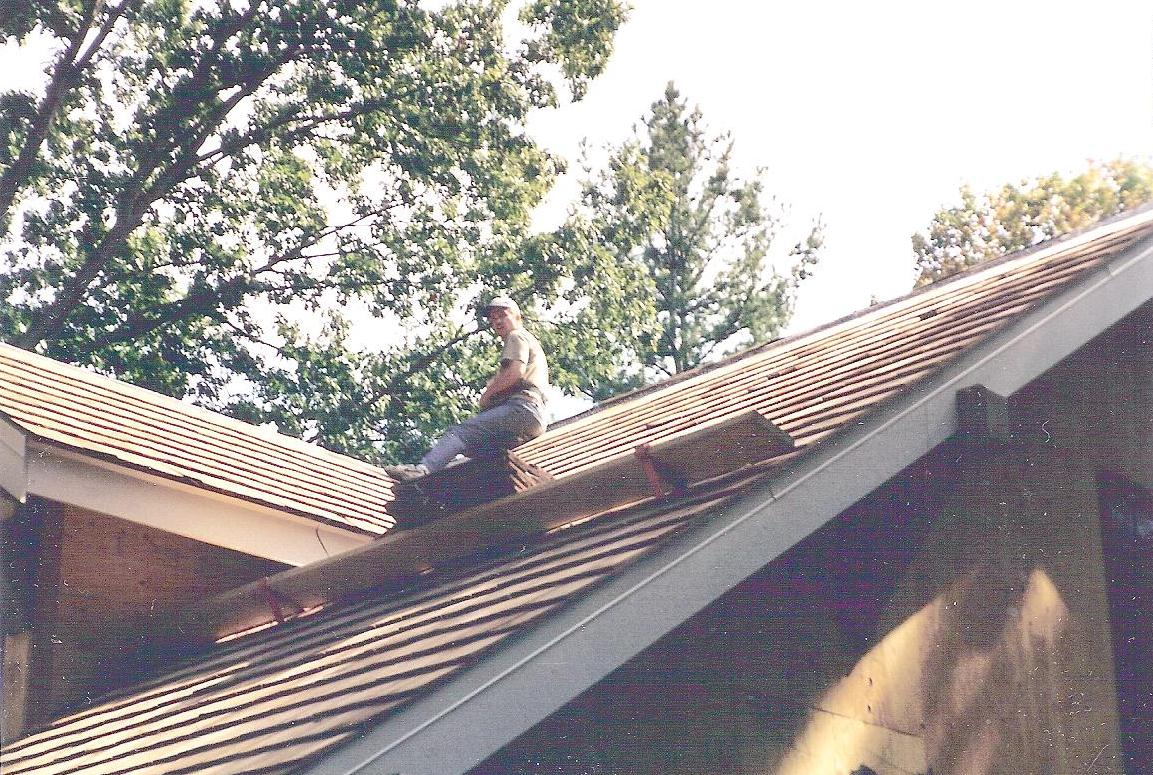
I remember when I framed, sheeted, and shingled the backside of our two-story garage (the top half is our guesthouse, or FROG—free-room-over-garage). The drop to the ground is only about twenty or so feet. It wasn’t the highest work I’d done, but just below it, about where a falling object—say a person’s body—would naturally land, is a wooden fence (see picture). When I did as Lisa’s mother advised, and imagined the worst, I pictured falling backward, landing with my back (or worse–we won’t even talk about a straddling landing) hitting the fence top. Then I easily conjured an image of myself laying there with a broken back. Of course in my imagined scenario I’d be paralyzed, so there would be no way to dial a cellphone for help. And so on. Imagine yourself there, and let your own fears run wild if you dare. Might I suggest the addition of a wandering bear or wolf pack?

Good-To-Go With Vertigo: So you might be asking yourself how I did it. The secret will sound pretty simple. Forward focus. It’s more like a philosophy than a way of seeing with your eyes. It involves more than simply not looking down. Whenever I was on high, I focused all of my attention on each and every movement needed to get the job done. I’m not talking about big stuff either, like ‘today lay and nail the plywood sheeting onto the rafters.’ I’m talking, ‘put your left foot there, now your right there; now put your weight on your left hip; now reach to your tool belt, get out a hammer and a nail; now drive the nail into this corner of the plywood, etcetera, etcetera.’ I know it sounds cumbersome, and it was, but it got the job done each time. By truly focusing my all on getting each step done, I didn’t have the time or attention to be diverted to imagined paralysis or wandering wolves (no, we don’t actually have wolves or bears in our woods). And each day I survived added to a small store of accumulated confidence—until the next roof job, where the process starts over again (damn it!).

Fear and Self-Loathing in Rewrite-ville: Turns out I’ve got some pretty powerful fears regarding my writing, too. Fear of rejection is the most obvious. It can be difficult to share something so personal, let alone offer it up for subjective judgment by the world at large. And it only gets worse, I know.

Turns out that the farther you go in the process, the deeper you must ask yourself to go. During the rewrite process, in order to make your work the best it can be, you have to dig deeper, for the darkest stuff inside you. The deeper and darker you go, the more dire the obstacles for your characters, the better the work—the more likely you are to succeed. As sure as you ratchet up the fear and peril for your characters, you are ratcheting up your willingness to lay your own deepest fears and most hidden inner demons on the table… For all to see! Ironic, isn’t it?  

I’ve been navigating the angst-inducing publishing minefield in the same way I approach carpentry on high. Taking it a step at a time. First draft, check. Rewrite without knowing what you’re doing, check. Find a group of beta readers, done; try to respond to their feedback, got it. Write query letter, check; submit work—scary, but okay. Rejections all around *Cue cartoon deflating balloon sound-effect*

Okay, what’s the next step? I know, write another one—a prequel (okay, that step was mostly avoidance, but it turned to be helpful, and at least it kept me writing). What else can I do while writing prequel? Hire a pro—very scary, but did it! See? Step by step, inch by inch.

From Baby Steps to Big Ones: I just shared the last manuscript of the trilogy with my fabulous development editor, Cathy Yardley of Rock Your Writing. Some of my deepest, darkest stuff, the toughest to share, is in book three, and I feared the worst. But you know what?—I survived. She didn’t laugh at me (I don’t think) or tell me it was awful or that it would never work or that I had to change any of the major elements. She told me it needs work (quite a bit). But that should’ve been a given, right? In fact, she singled out some of that very deepest, darkest stuff as being some of my most effective writing. Go figure.

My point is, the farther you go, the bigger the steps, but the more you gain of that accumulated confidence with each one. The next steps for me are big ones—a major overhaul of the opening of book one, an accompanying rewrite (all to dig deeper and go darker), and then resubmission. But I’ve been up on this roof for a while now. I’m still scared, every day, but I’m feeling pretty good about my footing. I can allow myself to glance up and see the peak ahead. This job’s nearing completion. I’ll have to start all over again on the next one, but those are steps I can’t focus on yet.  

Taking the Longview: Some of you might be wondering what all of this has to do with Pressfield’s ‘career-in-potential’ advice. A funny thing happens after you’ve been on the roof for a while, after you’ve accumulated a small reserve of that confidence. You can start to look around, and enjoy the view. It’s still scary as hell to look straight down. It can take you right back to imagining laying down there with a broken back, unable to dial your cell. But as you near the peak, you can take the longview. You see things from a new perspective. From where I am now, thanks to the encouragement of my tribe, the affirming praise of some of my beta readers, and inspiration and instruction from pros like Steven Pressfield and Cathy, I can even see the shelf that will someday hold my books, which I can imagine more clearly than ever before.

I can’t imagine I’ll ever fully defeat my fear of heights. But I know I can keep my fears at bay well enough to enjoy the views from wherever I am on my climb. And the higher I go, the more lovely the view.

And you? What are your fears? Does imagining the worst help you deal with them? Do you have a coping method or mechanism? Have you accumulated enough confidence to take, and enjoy, the longview?

A Sword By Any Other Name (…Would Still Just Be a Hunk of Sharpened Steel)

The Grande Ludovisi Sarcophagus – Depicting battle between Roman soldiers and Goth warriors.

“Every writer making a secondary world wishes in some measure to be a real maker, or hopes that he is drawing on reality: hopes that the peculiar quality of this secondary world (if not all the details) are derived from Reality, or are flowing into it.” ~J.R.R. Tolkien

Names—I haz ‘em: Lots of ‘em. My trilogy is based on the world of the epic culture clash between the Germanic tribe of the Goths and the ancient Roman Empire. Tom Shippey, Tolkien’s biographer, makes a case in J.R.R. Tolkien: Author of the Century, that for Tolkien everything started with the names. I took him to heart. One of the first things I did, before I wrote a single line of prose, was to come up with the names.

I just found my notes, dated January ’04 (I started outlining the story in November of ’03). I made lists of Gothic, Old Norse, Greek, and Latin words I thought were pertinent to the story and the world I wanted to create. I invented names not only for characters, but for nations, tribes, cities, seas, provinces, empires (yes, plural), oaths, clans, religious elements and ceremonies. I have characters with invented names as well as invented titles, and even invented nicknames. I even named a few swords (are you scared yet?). Heck, I even named the horses; over a dozen of them (now you’re scared, right?).  

“Names, especially names which are not strictly necessary, weight a narrative with the suggestion of reality.” ~Tom Shippey  

Namey-Namer: So did I do this just to emulate my literary hero? Just to be clever? Well, maybe those were a tiny part of it. But it turned out to be a very immersive exercise. In some cases, I’m not sure if I created the name to fit the character or the character emerged from the name. For example, my heroine’s name is Ainsela. She is the daughter of a warrior queen, and her birth was associated with the coming of a prophesied upheaval for her people. In the ancient Gothic language, áin is one, but áina is a ‘particular’ one—it denotes a certain or special singularity. Sela is a Greek moon goddess, but in Gothic a silda is a wonder or a marvel. Ainsela’s tribe’s patron goddess is a Teutonic moon goddess, Horsella, who is also the patron of untamed nature and all things wild. Hence, Ainsela is ‘the special one, a marvel, born of untamed nature.’

Yes, I did something like this for every one of my names. Not all of them were quite this elaborate, but they all have meaning. Some I just had fun with, for example the names of two of the Roman antagonists. Malvius is rooted in the Latin malevelle: of evil intent. And Turgian is from the Latin turgere: to swell (as in his head, with pride).

Submariner: In the pursuit of creating my own distinct world, and in the interests of relating the story without the encumbrance of historical facts, I even changed the names of all ‘real’ places and peoples. I made the Romans into Tiberians, the Goths into the Gottari, and so on. I explain why in a bit more depth on the homepage of my website in a post called The Origin of Epic, but to summarize, I did it to gain a bit of distance from the readers’ preconceptions. I was hoping to accomodate total submersion in my world, to take readers on a voyage without having them bring their baggage onboard the sub. As Tolkien says above, I was hoping not just to draw on reality, but in the creation of a peculiar quality derived from Reality, and that this Reality would then flow into my world. I wanted the reader to lose themselves not in historical detail, but in story. I know there will be those of you who feel otherwise, but I believe that by suspending disbelief through world-building, the best historical fantasy actually puts the spotlight on story, thereby enhancing the emotional experience.

It can get a bit complicated, but so can actual history. In the interest of simplifying, I made up a glossary doc. In the beginning it was just a reference for me. It has over 150 entries. I ended up rewriting it in the voice of the trilogy, including a pronunciation key for each entry, and I offer it out to beta readers. I’ve had several say they enjoyed having it, a few saying it was a necessity, and one saying it intimidated her so much she never read the book. But most have said they hardly gave it a glance.

Literary Trip, or Trip-up? I know what some (if not most or all) of you are thinking. Something like: Are you nuts? Why would you trip up the reader? Why make it any harder for folks to get into your story? Why add something that will make it more difficult to get published? The names don’t have anything to do with the story, right?

To answer those questions, in order: Perhaps (by whose definition?); It’s not my intention; I hope it doesn’t, and that for certain readers it’ll aid in their submersion into story; Because being published wasn’t on my mind when I started; And that last one is a bit complicated, and perhaps is my point here (in case it’s not evident). For me, story emerges in part from world-building, and world-building emerges from names. So for me, the names have quite a bit to do with the story that emerged (I’m still a pantser, after all).

I understand that a lot of the ‘tripping up’ of readers by names can be avoided through their judicious introduction, through their being woven into the fabric of story deftly, and I’m working on it. But I am pretty darn fond of them, and couldn’t be easily convinced to change too many of them. I mean, there was a time when names like Frodo and Gandalf, Hogwarts and Dumbledore all sounded bizarre, but can you imagine any other name for any of those?

Back to those hunks of steel: The two named swords in my trilogy (Nahtsrein and Bairtah-Urrin for those who are interested—Ruler of the Night and Bringer of Light, respectively) are not magical. But they are more than mere weapons. They are emblematic of the leadership of the two ruling clans of the Gottari. They are just symbols, analogies for power—their importance placed upon them by the Gottari people. And isn’t that what story really boils down to? Stories are symbolic analogies for life.

So what’s in a name? Quite a bit… In my book, anyway.

What about you? Do you think I’m nuts? (On second thought, don’t answer that.) Do names trip you up? Do you think this is all just geek-speak, reminding you why you don’t read historical fantasy? Or do you feel names can enhance the story? Or do they make no difference, as long as the story’s good?

The Way I Like My Rejections – Guest Post

I am so excited to welcome my friend Lara Schiffbauer for my first-ever guest post here on Seeking the Inner Ancient. It’s so appropriate, as Lara and I have a growing history of shared firsts. She was this blog’s first-ever commenter. Then she conducted an interview of this humble writer for her wonderful blog, Motivation for Creation–a first for both interviewer and subject.

Lara  is a talented writer I first met via Writer Unboxed. She and I bonded over our mutual love of Star Wars, and we have since been sharing the road toward publication together, which leads me to her topic for the day. It’s one I’m all too familiar with, and I couldn’t be more delighted by her views and advice on a subject we, as writers, all face.

Take it away, Lara:

This summer I entered the dubious country of Queryland.  I finished my manuscript on May 30th, and crossed the threshold into the world of query letters, synopses and rejections, oh my!

Queryland isn’t exactly a warm, fuzzy place.  Nor is it totally unknown to me.  I started submitting short stories about two years ago, and amassed quite a few rejections before I got some acceptances.  I’ve been querying my novel for a month, and now have four or five rejections under my belt.

Over time, I’ve realized certain rejections are preferable to me, and certain rejections aren’t.  I also realized I’m only at the start of Rejection Trail for my novel, and I better come up with a method to handle all the stress without becoming suicidal (joking!)

Three Ways I Like My Rejections

Quick – The first rejection I ever got, I received less than twenty-four hours after I submitted my story, Bear Hug.  I later submitted to an audio short story book publication which took eight months to reject it .  I learned that quick is better.  A quick rejection allows me to move on, and hopefully get the story to a person who thinks it’s as cool as I do.  The only downside is that you can rack up the rejections faster, too!

Friendly –This is where I like the magazine rejections better.  I don’t know if they had any less submissions than the agents I’ve sent my query to, but three of the rejections for Bear Hug wrote back really nice, encouraging (albeit short) comments.  It was like using a doe-skin glove to slap my face rather than a chain mail gauntlet.

 Do No Harm – At the very least, I prefer my rejections in the form of a form letter.  I know that sounds odd, but the alternative can be evil.  I’ve read stories of scathing rejections.  That kind of nonsense is cruel and unhelpful.

Three Ways I Don’t Like My Rejections

Ganging Up – It doesn’t matter if I’ve sent queries/submissions out months apart, they will inevitably end up back in my e-mail box on the same day, or insanely close to each other.  This has happened frequently enough that last week when I got one rejection on Tuesday, I asked my husband if he wanted to take bets on which day the second would come in.  I was surprised it waited until Thursday.

Well-intentioned Mean Stuff – I have a friend who received a rejection from an agent who, after telling my friend what she liked about the story, told her to “bone up on your grammar.”  My friend does not have a grammar problem.  I believe the agent was trying to be helpful, but it didn’t end up helpful at all.  The upside?  If nothing else, the whole interaction let my friend know that she didn’t want to work with that agent, anyway.

Bad Timing – No, there is no good time to receive a rejection, but there are definitely times that are worse than others.  Remember that rejection I received on Thursday?  It came about ten minutes after I had just had a fabulous plotting session for my next novel.  I was flying high on creativity, and thinking “Yes! I can do this writing thing.”  I didn’t even get a full evening of feeling competent before the rejection came in.  Please, please, please, gentle rejection, give me a chance to feel some pleasure before the pain!

So What’s a Writer to Do?

I have identified three things I do that help me get my brain straightened around and remember a rejection is not the end of the world.  Really.

Exercise – There are two reasons why I think exercise helps.  The first is the endorphins, as well as the serotonin, dopamine and adrenaline, which are released and work together to make us feel happy and have happy, creative thoughts.  The other reason is because by exercising we can burn off the frustration we feel with each and every rejection.  Or, am I the only one who gets frustrated?

Chocolate (or some coma inducing junk food of your choice) –  I have long reacted to stress by eating.  When my date for the senior prom ditched me a week before the event, I ate a half-gallon of cherry nut ice cream in about a half-hour flat.  What I have learned over the years is moderation.  Put a limit on how much you can indulge yourself, and then go for it, if you want.  It’s called comfort food for a reason.  Sometimes we just need Hersheys to kiss the boo-boo on our writer egos.

Write, damn it! – There is no substitute.  Kurt Vonnegut says it best.  “You must stay drunk on writing so reality can’t bite you in the ass.”  That’s the version I live by.  Reality, and rejection, can be a nasty you-know-what.  Writing is a magic pill that takes me out of myself and my insecure feelings, and plops me into a place full of witches, angels and happy endings.  It’s a much more preferable place to be.

How do you handle rejections?

 Lara Schiffbauer is a writer, licensed clinical social worker, mother of two, wife of one, and a stubborn optimist.  She loves Star Wars, Lego people, science, everyday magic and to laugh.  You can find Lara on Twitter at @LASbauer, or at her blog,  Motivation for Creation.