Keeping the Faith (In Spite of All Contrary Evidence)

Planning to write is not writing. Outlining, researching, talking to people about what you’re doing, none of that is writing. Writing is writing. ~E. L. Doctorow

Painting of Thomas Paine writing at his desk by candle light.Writers Write, Right? So I’ve been remiss. For almost three months. Oh, I’ve dabbled, written a few posts and letters, etcetera. But I hadn’t composed any new prose since November—until last week. That’s when it hit me. I’ve been driving myself bonkers by avoiding actually writing. I’m not sure how many times I need to learn this lesson, but this was not the first time. Apparently I’m a slow learner.

As to how I came to renew the realization, suffice to say I found myself rewriting a chapter in book two that had been made redundant by book one revisions. The two days I spent doing the new chapter were amazing. I felt so alive—exhilarated even. I hadn’t had these particular characters in my head and my heart like that in a long while. But they sprang right back to life for me, their voices as clear as ever. I didn’t realize how I had been missing them. Finishing the scene was cathartic. I was quite moved, feeling like I was floating on the ether for hours afterward.

Writers Obsess, Right? Then, as with any great high, I came crashing down. Reviewing book two brought me back to reality. It still needs work. I still have my editor’s notes. A big job awaits me there, which is both exciting and daunting. Like many writers, I both love and hate my own work. I know I will never be singled out as a poetic or masterful wordsmith. Don’t get me wrong, I’m not without confidence. I will always strive to be a better writer. I love my characters and my story. I feel good about my world-building and characterization. I aspire to be an improved wordsmith and a great storyteller. And I’m persistent.

I’ve experienced my share of self-doubt. I’ve even written a post admitting to (okay, whining about) my occasional lack of faith in myself. If you asked me when I last felt insecure about my abilities as a writer, I’d probably ask you what time it was, so I could tell you in hours rather than days or weeks. I’ve lain awake in deep despair, trying to convince myself I should shelve the trilogy and move on. But I can’t do it. I can’t because I still believe in my story (me, not always so much, but the story, oh yes). I know in time the story will find its place in the world. How do I know? That’s what last week’s experience led me to ponder, and why I am writing this post.

The (Abundant) Contrary Evidence: I admire and respect Jane Friedman. I consider her a gift to writers. And she’s been very kind to me over the years. A few months ago, she wrote a wonderful post titled: How Long Should You Keep Trying to Get Published? In the article, she singles out first manuscript attempts as problematic. I’m seeking to publish my first. She also says: “A writer who has been working on the same manuscript for years and years—and has written nothing else—might be tragically stuck.” Um, years and years? Yeah, nine of them. There is a caveat in regards to my work, as I have four complete manuscripts, but they are all set in the same world, and I can even make a case that they’re all essentially part of one large story. As I said, I respect Jane, and suspect her observations here are most often correct.

I’ve also been told that my work is too long, that series books by debut authors are ill-advised, that I should’ve limited the number of POV characters, that historical fantasies set in an alternate Europe are passé, and that fantasy fans want a well-defined system of magic. I’m on the losing side of each of those issues. Clearly I have a lot to overcome when I submit. And yet I still believe, and persevere.

“We who make stories know that we tell lies for a living. But they are good lies that say true things, and we owe it to our readers to build them as best we can. Because somewhere out there is someone who needs that story. Someone who will grow up with a different landscape, who without that story will be a different person. And who with that story may have hope, or wisdom, or kindness, or comfort. And that is why we write.” ~Neil Gaiman

safeIn the Vault: Over the years I’ve carved a niche in my heart for my belief in my story. It’s a lockbox, hidden away from the world and, sometimes, from my own self-doubt. Neil’s quote sits nicely in that niche. I believe there is someone out there who needs my story. And that belief only gets stronger as I forge ahead. I know I must strive to make it the story it’s worthy of being—to make sure it gets through to that someone who needs it.

Writerly Debt: Neil says we owe it to our readers to build our stories the best we can. Two years ago, in the comments of one of her Writer Unboxed posts, I asked the aforementioned Ms. Friedman if there was a way to know if I should shelve the trilogy and move on. She was not only kind in her reply, but wise. She told me to ask myself not how long I’d worked on it, but whether or not I was still growing as a writer. I knew that I was. In the two years since, I’ve have endeavored to strengthen my story, and I know I’ve grown in the process.

It’s through this growth, and with the help and guidance of my mentors and fellow writers, I’ve come to recognize mine as good lies, and to see that they say true things. I know by continuing to persevere I can make them not just more seamless but more powerful, and that my truth will resonate all the clearer.

Hidden In Plain Sight: Only in pondering this post and writing it have I come to realize that my vaulted belief is rooted right there in my story. I have two MCs who must keep the faith. They are striving for something that seems such a distant hope, against seemingly insurmountable odds. My male protagonist fears he hasn’t enough courage to face his destiny, but—step by step, in spite of the ever increasing odds against success—he endures. And in doing so, he finds there is courage just in continuing to strive.

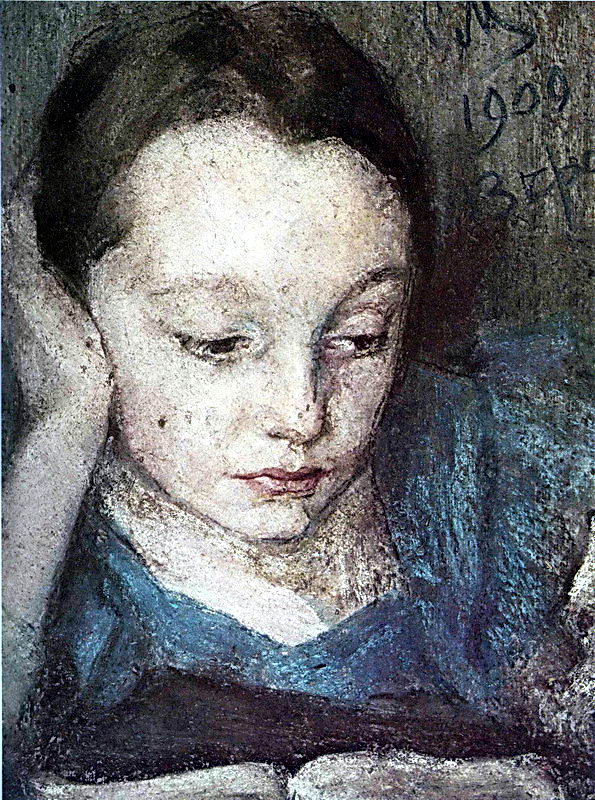
True Lies: My story is about finding courage you didn’t suspect you had, facing your fears, making difficult choices—choices that lead to sacrifices for a belief, and for love. And inPortrait of Vera Malytina, by Sergei Malyutin making those brave choices comes the knowledge that you can live with the consequences of your decisions, because you were true to yourself and to those you love and who love you. These are my good lies, my true things.
Yes, I’ve kept my belief locked away, but by sharing it with you here I take a small step toward finding my own courage. And I’ll need courage to persevere, and to deliver my story to the someone who needs it. Only if I am brave on the page will that someone find hope, or wisdom, or kindness, or comfort there.

Feeling brave? How do you keep the faith? 

Image credit: jgroup / 123RF Stock Photo
Redirect to Hugs & Chocolate – Headswerving (Mulitple POVs)

man-of-a-thousand-facesToday I have the honor of standing in for Heather Reid, taking her slot on Hugs & Chocolate, the wonderful writing craft blogging home of six talented writers. In the post I confess to headswerving. If you don’t know what that is, I’m afraid you’ll have to go and see for yourself. I’ll give you a big hint: It has to do with multiple POVs, a subject near and dear to my heart. I’m not quite the writing equivalent of Lon Chaney (or Sybil), but there are a quite a few characters running around in the ole noggin. Are you scared yet? Head over to my post for the frightening truth.

Getting Lost In History

The Wanderer Above the Sea of Fog, By David Friedrich Caspar (1818)“I believe that imagination is stronger than knowledge – myth is more potent than history – dreams are more powerful than facts – hope always triumphs over experience – laughter is the cure for grief – love is stronger than death” ~ Robert Fulghum

Lost and Found: I’m a sucker for a good historical fantasy, but I’d been feeling like I hadn’t read a good one in a long while. That all changed in the last few weeks, since I found a series of books, The Farseer Trilogy, by Robin Hobb. I’m on book three, and I’ve been told there is another trilogy in the same world, featuring some of the same characters. Huzzah! As each book ends, I take a look at my existing TBR pile, consider what to read next, then download the next edition of Hobb’s work. I’m totally lost in her historical fantasy world, and I’m delighted.

It’s more like wandering than being lost, I suppose (and remember, “Not all who wander are lost.” ~JRRT). In reading Hobb, I am wandering through the recesses of imagination, exploring ideas of my own. Her writing is so compelling, her characters so well-realized, that I have mostly been able to turn off my writerly internal editor. Her work still makes me think, not just about my own work, but life in general—probing my perception of the world. I’m more than entertained, I’m enlightened and stimulated to further and deeper examination of my thoughts and feelings. By getting lost in her historical world, I find myself anew. Now that’s powerful writing!

The History Behind the Historiography: One of the things the series provoked me to ponder is the why behind my love of historicals. As far back as I can remember I’ve loved imagining myself living in another time. One recollection of the early kindling of my ardor was a trip my family took to Mackinac Island (in Northern Lake Huron), and my first tour of the restored British fort there. I must’ve been about seven or eight. I stood on the wall walk, sighting down a cannon barrel across green hillsides to the blue straits beyond, imagining being surrounded by hostile French and Indians.

In the fort’s bookstore (yeah, pretty sure that’s a modern addition), my mom bought me a copy of Young Voyageur, by Dirk Gringhuis. I tore through the Shooting the Rapids (1879), By Frances Anne Hopkinsaccount of a young British boy sold into indentured service to a crew of French-Canadian voyageurs. My heart raced as Danny hid in an attic during the famous massacre at the fort, begun under the guise of a La Crosse match between Ottawa and Chippewa braves. I could picture the very spot! Pure preteen exhilaration. From 18th Century Michilimackinac, I was on to Middle Earth, Narnia, Arthurian Britain, and 19th Century India. And my love lives on, unabated.

The Legend of the Legend-Makers: One of the things Hobb points out about her quasi-medieval world is the importance of minstrels and scribes. Since the small folk of our not-too-distant past were mostly illiterate, and there were no other sources for news, the job of passing along important cultural information fell to traveling singers and mummers. And all that was put into record, from a noble’s vainglorious accounting of his deeds, to the land deeds and marriage agreements of freemen, had to be written by hiring a scribe. Wherever folk gathered, from the courts of the mighty to the neighborhood taverns to the wayside inns, minstrels and scribes were welcomed and heeded. Storytelling and publishing for the masses were born. Just as does our news of the day, the singers sang of what had happened, in part to pass it along and in part to help make sense of it—to show the audience how the stories affected them. But, of course, minstrels had an overriding goal–to entertain.

And, as everyone loves a good story, and stories are often made all the better by ever-so-slight modification—adjustments that with time and frequent retelling turn into outright embellishment—so too are legends born. If a warrior won the day, soon enough he had won the day nigh alone, and with one injured arm tied in a sling. We have a hero, ladies and gentlemen! And of course all would then love to hear the details of his motives, including the smoldering eye contact he made with that besieged nobleman’s wife after the battle. You get the idea. Thank goodness our modern mass news sources have gotten away from such sensationalism and puffery.

“To know the truth of history is to realize its ultimate myth and its inevitable ambiguity.”
~Roy P. Basler

To Yore Place, Then to Mine: It’s said that myths and legends exist to explain the unexplainable, that they cement the basic structures of societal belief, and reconcile difficult dichotomies, such as good versus evil and existence versus nothingness. What better way to illustrate such difficult subjects than to see what has gone before? “How did our hero fare in this difficult circumstance? What happened to our heroine when she dared to go to that strange place?” Seeing the hero through dire straits makes facing our own circumstance seem a bit less difficult, which is comforting and alluring. “Well, if they can get through that. Our lot is jolly when laid out beside theirs.”  Give me more. I want to get lost in the days of yore.

I have always been comforted by stories from the past, but nothing could compare to what I felt when I started to dig through history, mining for details for the creation of my fictional world. As some of you may know, my work leans toward the historical rather than the fantastic. Once I had picked out my era and setting—a place and time that sent a shiver down my neck in imaging living there—I couldn’t get enough. One of my biggest writing hurdles has been to refrain from piling on the world-building details. I want so badly to convey my tingling feeling over being immersed in my setting, but too much and I’ve cluttered up the story. It’s a delicate balance.

“Whoever wishes to foresee the future must consult the past; for human events ever resemble those of preceding times. This arises from the fact that they are produced by men who ever have been, and ever shall be, animated by the same passions, and thus they necessarily have the same results.” ~Machiavelli

Stripping To Be Romantic: There is a lot of romanticism in historical fiction and fantasy. We are offered a safe distance from which we can view a familiar world, but as it once was–dangerous and exotic. Legend and myth evoke a sense of mystery, often tinged with a sacred aura. We view well-known archetypes on a glorious stage, our preconceptions lushly painted by history’s continuum of minstrels and scribes, painters and poets. Not that a legendary feeling can’t be created in other genres. There is, for example, often such an atmosphere created in sci-fi or in dystopian fantasy. Heck, Star Wars is a perfect exemplar of  legendary romanticism.

In many ways, starting with a historical setting strips the process of story craft down to fundimentals, to be built on an existing foundation. Also, utilizing the window of history creates a safe distance and a legendary atmosphere for my tales. But for me there is more. I wanted the glorious painting but without the constraints of the existing stage. It’s why I write historical fantasy. Of course all history is fantasy–seen as we wish it to have been, and distorted by the lens of legendary storytelling. But I bent it a bit further. By building my own world, I was freed from history’s confinement, but (hopefully) left with our fond collective reminiscence. My setting is stripped of technology, modern convenience, and of our minute division of expertise; a place where safety is an uncommon luxury. I sought to build a world where the characters’ roles and conflicts are at once familiar and foreign, exotic and relatable.

By using history as a lever, I aspire to create an ease of passage into story. I’m hoping to take readers to a place that offers both comfort and exhilaration. A place that might even throw an occasional shiver down their neck.Arbo

What say you? Do you feel the romance of the past? Do you think history is a help or a hindrance to being transported into story? Does historical fantasy convey a legendary feel to you, or do you roll your eyes at us geeks?  

A Sonic Summoning of the Muse

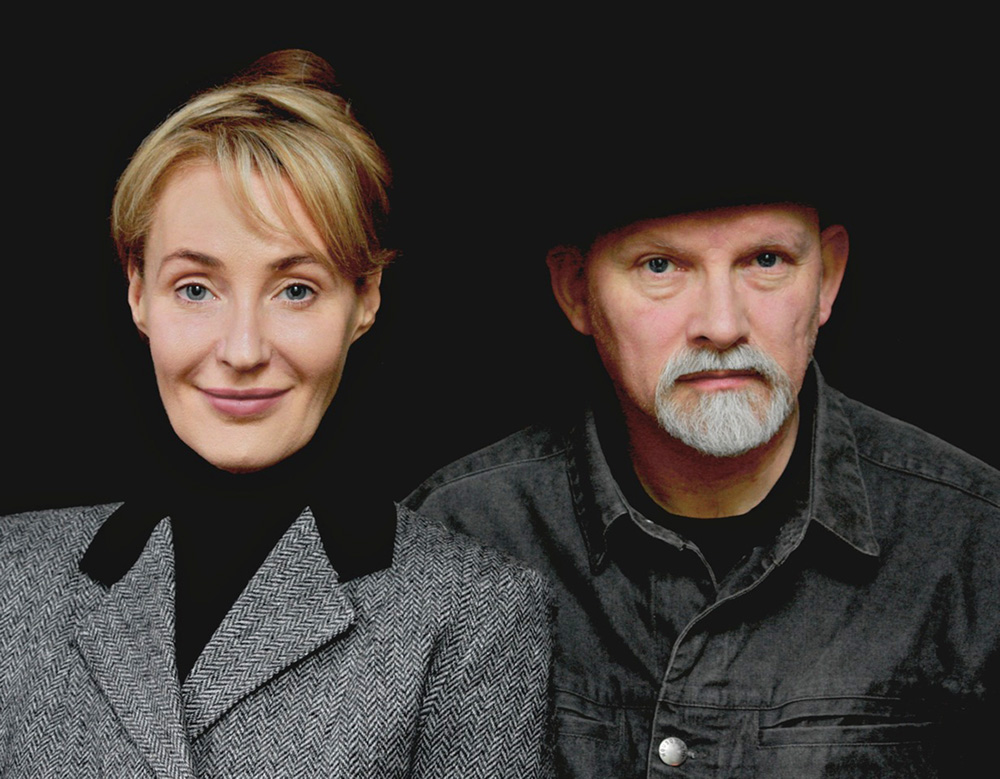
dead can danceToward the Within: Dead Can Dance. Three words that, for better or worse, carry a lot. Have you heard of them? If not, I’ll tell you about them in a minute. But this post is really about a special kind of magic, and for you, perhaps Dead Can Dance will have nothing to do with it. Writers often speak of inspiration. But for me this post will go just a bit beyond inspiration and slip into the realm of magic.

Dead Can Dance is the talented duo of musical artists Lisa Gerrard and Brendan Perry. Their music is truly unique, blending Turkish, Balkan, Celtic, Bretagne, and Persian modal traditions into a unique and varied artistic vision all their own. They came together in Australia in the early eighties, later moved to London, then went on to create their own studio in an abandoned church in Ireland. They disbanded in the late nineties to pursue successful solo careers. To my great happiness, Lisa and Brendan reunited in ‘12 for a new album and tour.

They coined their name to imply how cultural history, and even instruments, made of wood and animal skins, could still conjure human emotion and bring about joy—how something that was rightfully dead could still dance. Early on they were surprised and chagrined to find that, probably in part because of their name, they had gained a large following among Europe’s gothic youth movement. You know, the goths I wrote about here a while ago—the ones my mom doesn’t like.

“Our inspiration comes from within. It’s a voice, an inner voice, a primal voice; it’s one that’s been inside of man for centuries, for millennia. It’s a small key, in his heart, a reminder of who he is, you know? And it’ll be replaced, across the generations. My part will be replaced, when I’m dead, and some other artist hears the voice, and carries on the work.” ~Lisa Gerrard

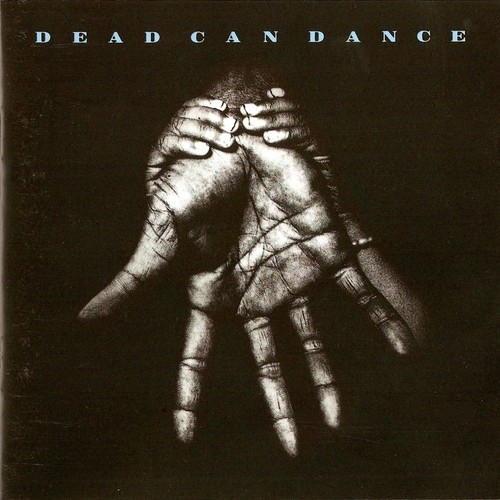
Indoctrination (A Design for Living): Being a Cocteau Twins fan from early on (which I wrote about here), I was vaguely aware of DCD because the two bands shared a record labelDCD Into the Labyrinth Cover in 4AD Records. Both bands had been musical guests on the popular This Mortal Coil collaborations. But I hadn’t collected their albums.

When I first started writing fiction, I knew music would be a part of it. I’d always read with music on, and had long known that certain kinds of music enhanced the experience. And I knew which music worked for my chosen genre of historical fantasy. I know music is a distraction for some writers, but I’ve never been distracted. Quite the contrary. Very early in my writing life I found that the right music, especially at the start of a session, aided my immersion into the world of my story—even into a certain scene itself.

Windfall: During one of my earliest writing sessions, I was listening to This Mortal Coil’s song, Waves Become Wings, which morphs into another song, Dreams Made Flesh. Not only was the mood of the two blended pieces perfect for the scene, the female voice in both songs almost seemed to be that of my character, speaking to me about the scene. The experience blew me away. I wanted more. I immediately googled the songs, and found out the singer was Lisa Gerrard, of Dead Can Dance. A musical obsession was born. I think I own every track ever recorded not only by DCD, but by both Lisa and Brendan as solo artists. Many of you may know Lisa’s voice from her work in movies such as Gladiator and Whale Rider. Many of these tracks have over 200 plays in my iTunes library. As with the Cocteau Twins, I even love their song titles. [Note: all of the subtitles in this post are DCD song titles.]

Anywhere Out of the World: I have listened to hundreds of other songs by scores of other artists while I work, and I have been inspired by them. And yet, to this day, certain DCD songs will instantly evoke a certain scene or scenes, some of which I wrote almost a decade ago. In mere moments, I am transported. Lisa Gerrard’s voice, often chanting incantations in a dead or unknown language, has become the very voice of the Skolani (my all female warrior tribe). Other songs, mostly sung by Brendan or instrumentals, evoke the world of the imperials in my story.

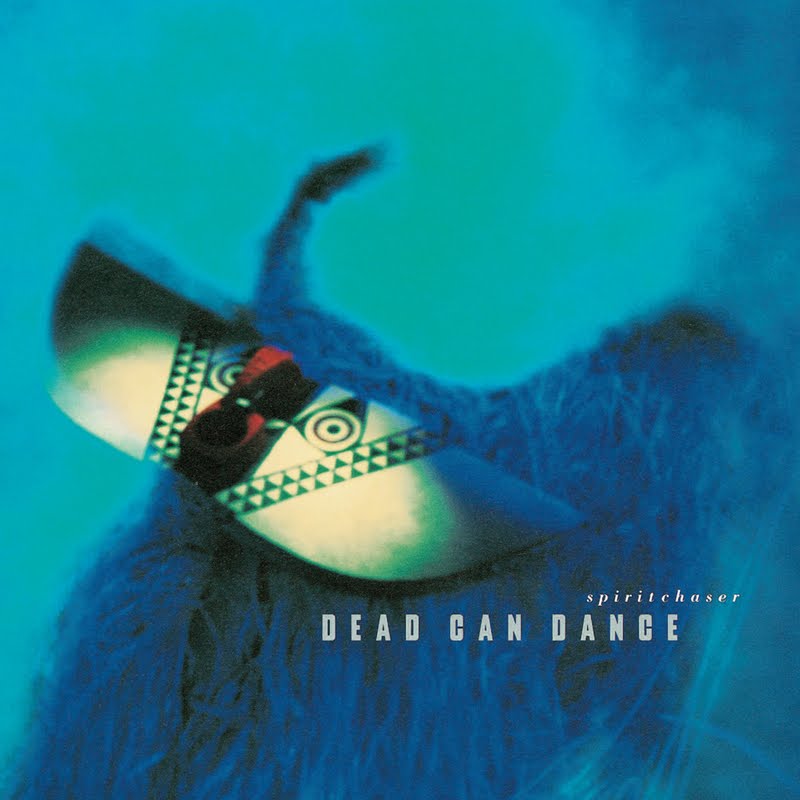
Dead Can Dance 1996 SpiritchaserMesmerism: For example, Lisa’s chanting accompanied by tribal drumming in the song Bird immediately puts me in the lush forests and mountains of the Pontean Pass, where Skolani Blade-Wielders prowl in stealth, diligently watchful for intruders to their homeland from the seacoast cities of the imperials. The live version of the song Cantara tiptoes in like a hunting war party, then gallops into an encounter with the foe, building to a battle-frenzied finish, perfectly emoting the rush of combat and the thrill of victory. Hearing it, I am instantly transported to the culminating battle of book two (the Battle of the Oium Plains, for those in the know). And this has happened with dozens of scenes and DCD songs over the course of my four manuscripts. Not only were they an inspiration, a part of creation, but the music is an instant portal to another place and time–another world. Hopefully, another world that can become a touchstone for others.

Compassion: “…If your heart is hurt or lonely, [the musical artist is] someone communicating to you who is not your friend, or neighbor, or mother, and they peel back the membrane of superficiality or mediocrity so that you can connect with it, and you can become a member of the human race. It says, “You have a right to be here.” You are not being patronized. There is a feeling that you can connect with something. I think that’s what God wants us to do. It isn’t necessarily about how we speak, or whether we look glamorous. There’s this essence that is sincere. When an artist makes something with sincerity, and is willing to make this journey while facing up to the horrible reality of their limitations and still manages to do this work, that becomes a safe place for others to come to and build from there.” ~Lisa Gerrard

In the Wake of Adversity: Perhaps the most transporting of all the DCD songs to a certain scene for me is the gorgeously mournful The Host Of Seraphim. I am listening to it as I type. I can immediately see my character in the scene, weary from her efforts, desolately surveying the wreckage, the waste and death in the aftermath of battle. Then, at 1:50 into the song, she sees a fallen comrade, someone dear to her. She runs to them. She believes it is her fault. For me, her grief and regret float on that ethereal chorus. But I know that for a hundred other writers, a hundred different scenes could be wrought by this haunting orchestration.

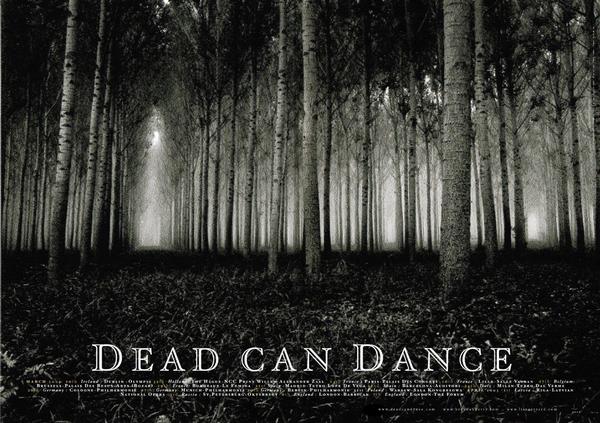
Mother Tongue: Even now, having the scene I just described brought to life through music, my neck pricks, my eyes instantly glassing. This amazes me. I am aided to a state of joy, DCD Concert postersorrow, or awe by the art of another, in hopes of inspiring joy, sorrow and awe in others. As I said at the onset, music truly is a special magic—one of mankind’s finest achievements. It is a triumph which sets us apart. Even when I don’t know the language Lisa is singing, I am connected. That, my friends, is art. And, for me, magic.

Dead Can Dance shines a light for me, guiding me to another world—a world of my making. What a special gift they have bestowed. Like storytelling, music brings us together, lets us know we share the human condition, that we are a part of something larger. One day I hope to pass along this gift to my readers.

Don’t Fade Away: Tell me how music relates to your journey. Do you listen while you write? Who is your DCD?

“It Was a Dark and Stormy Night.” Of course it was.

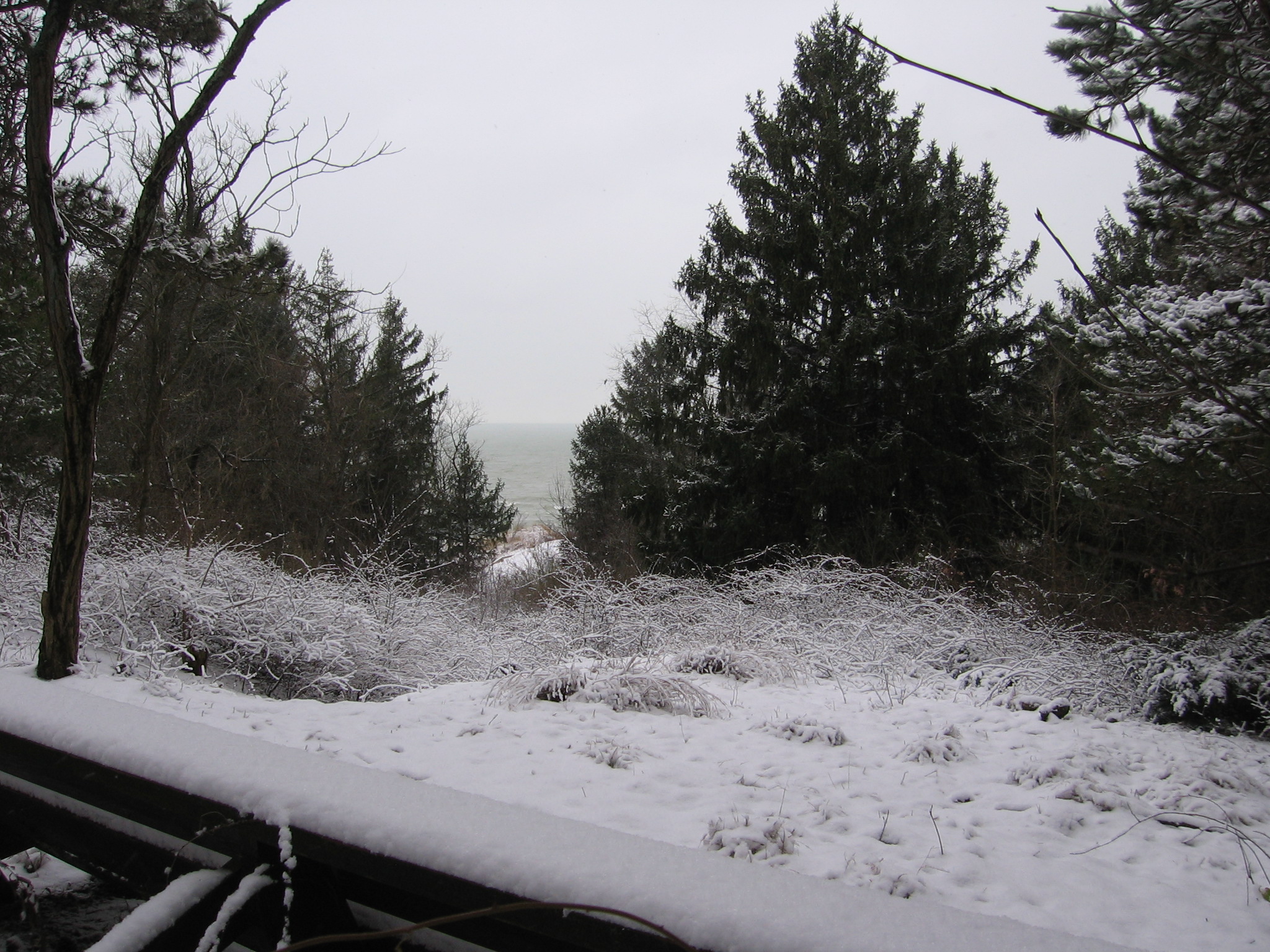
Winter View - Sunset Point“Oh, winter,
We are falling,
We are hiding,
We are hibernating.

In the depths of the wake,
In the depths of the dark,

In the depths
of our dreams,
And so it seems,
That winter comforts me.~ Susie Suh (Winter)

Gimme Shelter: There’s snow in the forecast. It was sunny when I started this post,  but the skies grow darker. I’m glad. As a writer I’ve always loved winter weather. Any kind of inclement weather, really. I do my best writing when the weather is stormy or harsh—anything but sunny and warm.

My friend Rhiann Wynn-Nolet wrote a wonderful post about how she is inspired by winter, with some really lovely photos. Go take a look at it, here. In it, she writes beautifully and poetically about the stillness, the beauty, and the clarity of winter. I heartily agree.

There is a coziness about winter, and it’s not just the coziness of wearing warm socks (I know some of you were waiting for the sock reference, so I thought I’d get it out of the way). Stormy weather makes me appreciate the comforts of my little cottage. It’s the perfect weather for cuddling by the fire with a book. They always talk about summer being ideal for reading, but I’ve always done more reading in winter. And I think that this fondness for winter reading is part of my preference for writing in winter.

But for me there’s something deeper.

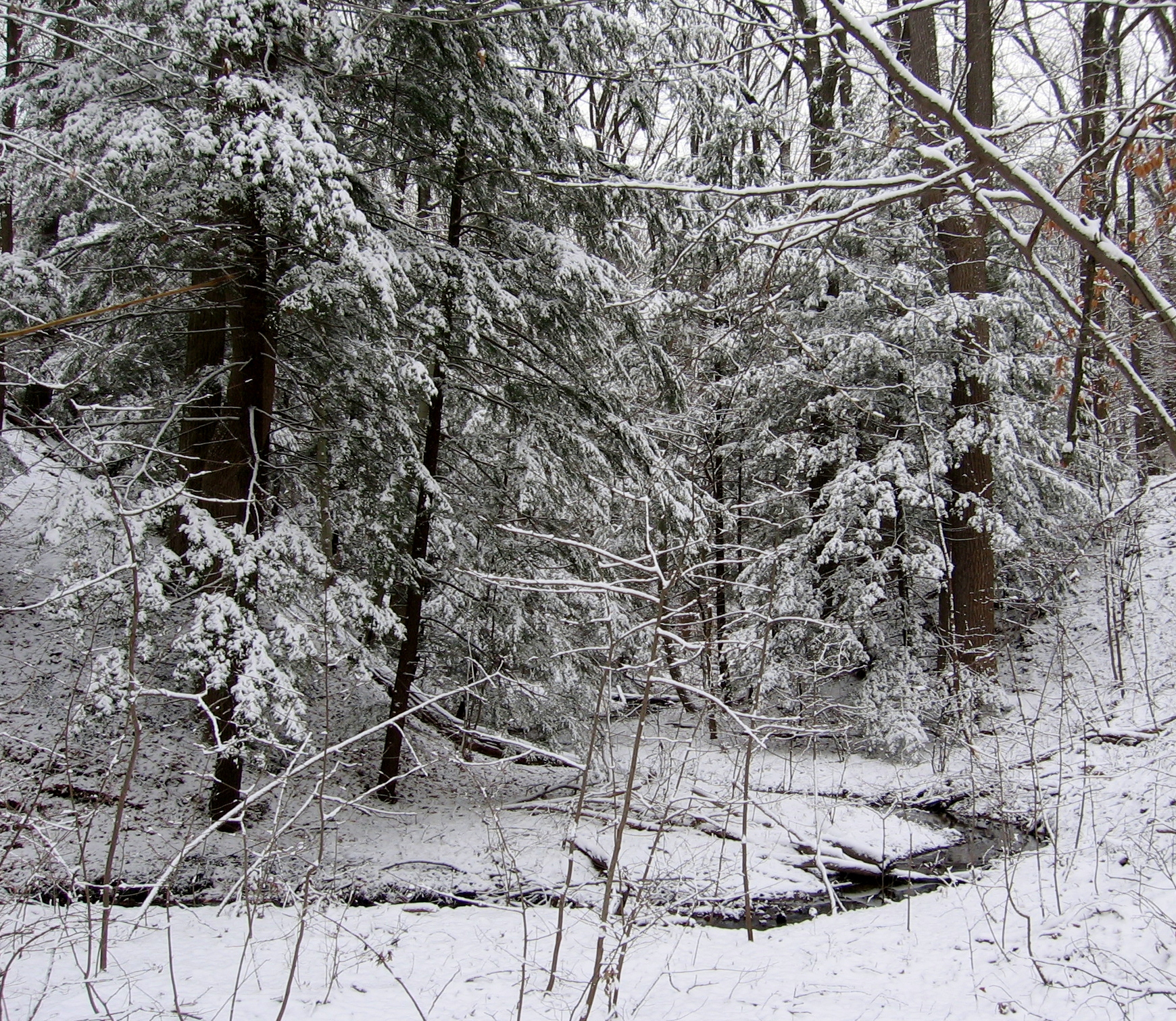
Winter in HazelhurstA winter’s day,
In a deep and dark December,
I am alone.

Gazing from my window to the streets below
,
On a freshly fallen silent shroud of snow
.
I am a rock,
I am an island.”
~ Paul Simon (I Am a Rock)

Rock + Island = Fortress: There is solitude in winter. There is reflection, yes, and silence. In the depths of winter, here in our little resort town, I am alone in the world. Alone with my thoughts, my emotions, my dreams. I am alone with my characters—my stories. Splendid isolation, as Warren Zevon aptly calls it.

During my daily walks there is only the muffled crunch of boots on snow, the wind through the firs overhead. Sequestered in my cozy office—my window on a frosty forest—there is no human voice, no beach-going tourists passing my window, beckoning my attention. Here in my fortress of seclusion, I am more easily transported into the world of story.

Carry on, carry on, carry on,
Our silver horn it leads the way
.
Banners of gold shine
,
In the cold, in the cold,
in the cold,
Footprints of snow, we’re b
lind from the road.
Hail!
~Anthony Gonzalez (M83- Intro)

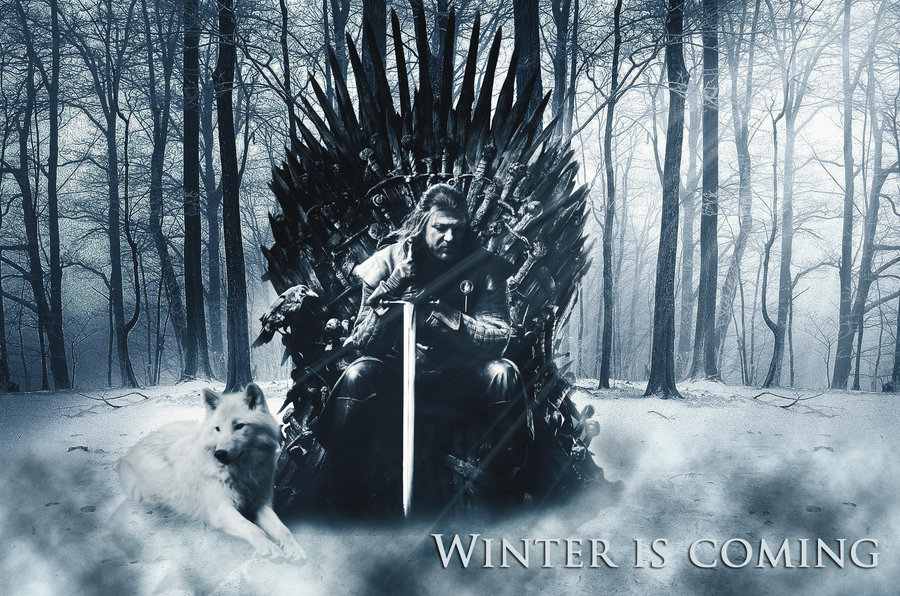
Winter Is Coming! I’m sure it’s no coincidence that many of the scenes in my four completed manuscripts are set in inclement weather. And I’m not alone. Many of my favorite Winter is coming-Game of throneshistorical fantasy stories rely on winter weather settings to create a mystique or a mood. Most notably, the ever impending multi-year long winter of GRR Martin’s A Song of Ice & Fire, much ballyhooed by the Starks, who made its coming their family motto. Winter also features prominently in the series I’m reading now: The Farseer Trilogy, by Robin Hobb.

There is something special about an impending storm—a potent cocktail of edgy anticipation and hunkering snugness. My characters endure swirling snow, bone-chilling wind, and stinging rain. My stormy mood is often imposed upon their world, creating a beautiful melancholia—the perfect backdrop for heightened conflict and emotional perseverance. Reading the trials of a favorite character in an epic tale is like experiencing the severity of the season through a frosty window pane, huddled under a throw in your favorite armchair.

My window on a snowy world.Are you an inclement weather reader or writer? Or perhaps neither—“just bring me my flip-flops and may palm trees swaying in a balmy breeze be the worst of my winter.” Either way, wishing you the season’s best!

Goals & Desires—Not What but Why

Give me a story and give me a bed, Give me possessions,
Oh love luck and money, they go to my head like wildfire
,
It’s good to have something to live for you’ll find
, Live for tomorrow,
Live for a job and the perfect behind—High time!”

~Harriet Wheeler & David Gavurin—The Sundays (from Can’t Be Sure)

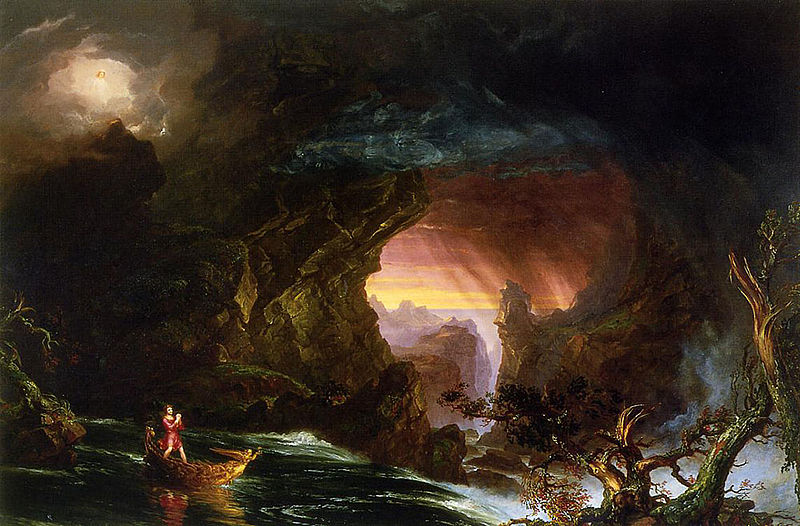
Thomas Cole, Voyage of Life - YouthCan’t Be Sure:  I’ve been conflicted and uncertain of late. It’s not so much that I’ve been unsure of what I want, although at times that’s part of it. It’s more that I’m not always sure why I want it anymore.

It’s the new year, and rather than making resolutions, I’ve been looking at my goals and asking myself some tough questions. In my writing mentor Cathy’s Rock Your Writing January newsletter she bid us to ask ourselves not just what we want but why we want it. Those of you who know me or follow this blog know I’ve long been seeking publication for my historical fantasy manuscripts. So that’s what I want, right? Publication. Seems simple enough. Ah sure, there are other goals for the year—polishing edit for book two, revision of book three, outline for a new project—but my primary goal is to seek representation and a traditional publication deal for book one. The really difficult question Cathy asked was the second part: Why?

I’ve paid plenty of lip-service to my gratitude to my muse (and my wife) for the opportunity for self-discovery and enlightenment bestowed by my writerly journey. Writing the books has been wonderful, and I’ve met so many wonderful folks along the way, including many of you reading. So isn’t that enough? What more could I want?

“And did you know desire’s a terrible thing,

The worst that I can find,

And did you know desire’s a terrible thing,

But I rely on mine.” ~Wheeler & Gavurin (from Can’t Be Sure)

Fame & Fortune: Would you believe me if I told you I’ve outgrown the desire for fame? Seriously, of all the selfish things I could wish for, fame would be at the bottom of the list. I’m not a fan of pop culture. If I pick up a People Magazine in the dentist office, I honestly can’t identify most of the celebrities pictured. I follow very few famous writers, I like alternative music, and I rarely go to movies. I don’t enjoy being put on the spot even at a large dinner party. I’ve done my share of public speaking, so it’s not fear. I just don’t care for that sort of attention. I’m certainly not driven to seek it.

Financial success is another subject. Everything seems to come back to money at some point. I understand that to make money as an artist, a certain amount of renown, or at least recognition, is required. In publishing, making money means selling books. To sell enough books, readers not only have to buy and like your books, they have to tell others about them. I understand this.

Even with an understanding of the workings of the free market, money is not a primary driving force in my quest for publication. I spent the first twenty-five years of adulthood focused on striving for fortune. Although I am far from financially independent, I have a roof over my head, food in the larder, and warm socks on my feet. I have a smart and successful wife who supports my artistic endeavors. Don’t misread me, I want my writing to make money. I’d like it to pay a fair share of our living expenses—for my artistic output to be self-sustaining of an artistic lifestyle. But the desire to make money does not adequately answer the question of why I want to be published.Thomas Cole, Voyage of Life - Manhood

R-E-S-P-E-C-T: I admit it, there is a part of me that occasionally says, “I’ll show them,”  in regard to getting published. Surely by now even my staunchest supporters have had their moments of doubt that I would get the job done. It’d be nice to have that tangible proof—evidence in the form of a physical book—that I am indeed a writer, that I made the grade.

And I must also admit that it’s nice to be praised and admired—respected, even. When you’ve spent years on a project, pouring so much of yourself into it, few things compare to the high of having someone tell you that they enjoyed it. Sure, it’s external validation. But I am human. Yes, for me, this one is insidious.

Although the quest for validation comes closer than fame or money as a driving force, I am doing my best to resist allowing it to be my motivation. There are many good reasons to self-publish these days, and they’re only getting more numerous. I even have a few of my own (genre mash-up, manuscript length), but for now my goal remains representation and a traditional deal. I’m convinced that, besides being stubborn, I am seeking this route because I want the books to be the best they can be—to have undergone a strenuous vetting process. At some point this might change, but I want to make sure it’s not for the wrong reasons (to thumb my nose at gatekeepers or in seeking an easier route to external validation).

I know that public validation, however sweet, would be fleeting. I know I have to find deeper meaning or I will end up perpetually, if cyclically, disappointed.

“But if desire, desire’s a terrible thing,

You know that I really don’t mind,

‘Cause it’s my life,

And though I can’t be sure what I want anymore,

It will come to me later.” ~Wheeler & Gavurin (from Can’t Be Sure)

Digging Deeper: Even if I can look in my heart and honestly reject the motivating factors above, I still haven’t answered the question. I had to go back to the beginning. I’ve mentioned here several times that my fantasy writing dreams go back to my school days. And yet those dreams were all but abandoned. In between my youthful notebook scribbling and starting the trilogy, I had another successful career—another life. I’m embarrassed to admit that I’d all but abandoned reading fantasy during those years as well. During my years in business I read mostly nonfiction.

Then something changed. A series of tragic events led to epiphany and life-change. If you are interested in details, Erika Liodice interviewed me about it here. In asking myself what I wanted this year, I asked myself what I sought when I started writing again.

It’s gonna be so good now,
It’s gonna be so good
,
Can you see the lark ascending?

Oh so romantic, swept me off my feet,
Like some kind of magic
,
Like the light in It
aly,
Lost its way across the sea.”
~Kate Bush (from Prologue)

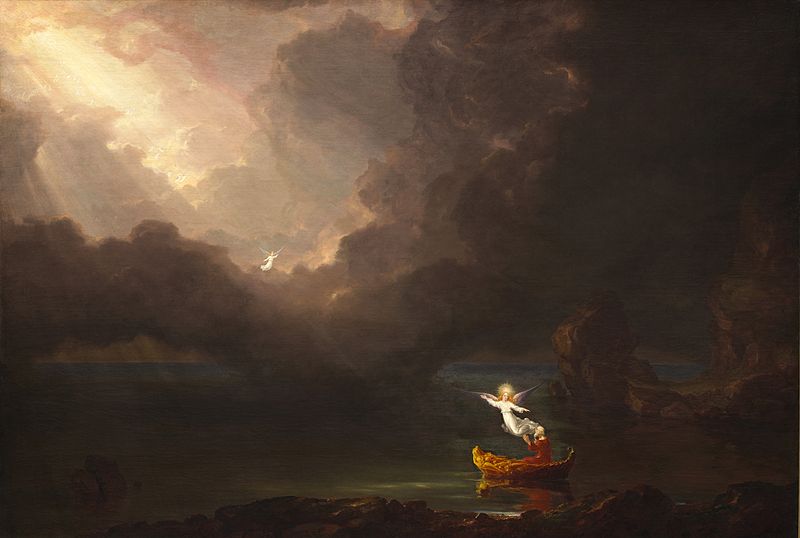
Thomas Cole, Voyage of Life - Old AgeMagic & Light: Tragedy always brings change. 9/11 and the death of loved ones had shaken me. In the months after our life-change I was seeking comfort and reassurance. I wanted to remind myself that life could be good again. I found solace in working with my hands again, and in spending time with my beloved. I found healing in music and art. And in books.

In the first winter after leaving our business, I wanted to revisit my favorites, and first on the list was The Lord of the Rings. I read voraciously that winter. I read or reread Guy Gavriel Kay, David Eddings, M.M. Kay and Marion Zimmer Bradley. I reveled in the glory, the friendship and the honor I found in the pages of historical fantasies. I felt renewed by the sacrifices for love, and experienced cathartic sorrow and release in the losses. In a real world that seemed unmistakably darker, I found light in fiction. I was healed, in no small way, by reading. I was reminded of the magic. And once again I wanted to be a part of making that magic.

Arcane Aspirations: I discovered an even bolder sort of magic in writing. The process of creating story has brought me to laughter and tears, and has filled my heart in an extraordinary way. There is mystery and majesty in the vocation I aspire to, and I am still but a humble apprentice. But I know I want to bring the magic and the light into the lives of others. This is what matters. I want to be worthy of being read. And to continue to grow so that I am worthy of it again and again. This is why I am seeking publication.

Happy New Year! May you all find your ‘whys’ as well as achieving your goals for 2013. Wishing you all writerly magic, as both practitioners and recipients.   

Interview on Writing the Dream – Redirect

Walking Belle on the BeachHappy New Year, friends! Today we start with a fresh slate. It’s a time of year to contemplate change. I had the honor of being interviewed on the subject of life-change by Erika Liodice for her lovely blog Writing the Dream. Erika and I met through Writer Unboxed, but got to know one another when we were both book reviewers for the old Reader Unboxed site. Now we are both columnists for the WU newsletter, Writer Inboxed. If you’re not receiving your copy of Writer Inboxed, you can sign up here.

Erika really got me thinking about what compelled me to finally chase my writing dreams. It really takes a leap of faith, and much of that faith must be faith in yourself. It’s not easy, and I still struggle with self-belief today, almost ten years later. So I wish for you all to find your inner strength and the resolve to pursue your dreams in the year to come.  Please head on over. I hope you enjoy the interview, and if you have a minute, please give me your thoughts.

Lessons For The Leader- Christi Craig Guest Post

Christi CraigI admire today’s guest. I introduced Christi Craig to you last week, when I had the honor of guest posting on her beautiful blog, Writing Under Pressure. In the wake of last week’s tragic events, and with the holiday season upon us, there’s been a lot of talk of giving of yourself. Rightfully so. Giving is admirable, but as Christi’s wonderful post today demonstrates, giving offers so much more. Read on, and you’ll admire her, too.

LESSONS FOR THE LEADER

 Once a month, I gather around a table with eight to ten senior citizens and lead a creative writing class. This isn’t an ordinary writing group, and these folks aren’t your typical writers. Yes, they bring stories they’ve written based on the previous month’s prompt, and we read them aloud, discuss them briefly. But, we meet for only sixty minutes in a small room. There isn’t enough time or space to dig into the craft of writing, and the acoustics in the room make it difficult for everyone to hear 100%. Yet, this group of writers teaches me plenty about the craft and inspires me beyond the page. They are proof that the exercise of writing sometimes plays a different role than telling the perfect story or creating a moving essay.

Insight

The first time I met with this group, I worried about my age and fitting in (I am two generations younger than a few of them). I thought I’d start our meeting with introductions. I’d tell them my background, list my credentials, ask about each of them and what they enjoyed writing. I planned an ice-breaker, so that we’d all feel comfortable reading our stories out loud to each other. But, once everyone sat down, the clock became the focal point. “Aren’t we going to start reading?” Someone asked. “It’s 10:30.”

As leader of the group, and as a writer in general, I got caught up in proving my worth. But, these seniors reminded me that 1) time is of the essence (senior citizens keep a very busy calendar), and 2) we’d all get to know each other as we went along.  Instead of talking about writing and storytelling, we serve ourselves better, at times, by getting down to business.

 Instruction

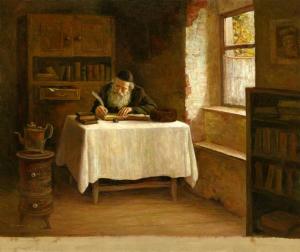
They’ve taught me about the nature of writing prompts, as well. My first prompt for them ran long and wordy. I listed several options to choose from, hoping to make the assignment easier. However, I made it much more difficult. They returned the next month with stories but expressed their frustration.Old Man Writing, by Boris Dubrov

I realized, then, that detailed prompts are confusing and kill the muse. My job as leader of the group isn’t to give them so many options that they freeze before they begin; I need only open the door for their stories to emerge. Now, my prompts are one sentence or less. And, I know they’re successful not by the quality of stories written, but by the responses that surround each story.

Inspiration

Most of the people who attend the class write personal essays. One woman is working on a collection of short fiction. Inevitably, someone shows up without anything to read. And, always, there is at least one new face at the table. Here’s where this group inspires me the most. When it’s time for the newcomer to share, the person apologizes for not bringing a story then follows with a similar response each time:

I have been here a year.

I have been here for three months.

I just moved in.

Everyone at the table smiles in understanding. You see, the heart of this group is in the fellowship. All are welcome, whether or not they love to write, whether or not they read a story. And, what happens around the table is magic. Someone reads a story about sending letters to a World War II soldier or moving into a 1940’s side by side home where the neighbor’s radio blares through the walls and entertains two families at once. Eyes light up, heads nod, and laughter erupts. Suddenly, a lively discussion breaks out. And, when the sixty minutes are over, people ask for the next prompt. They make sure they know when we’re meeting again.

I am a struggling writer, making my way slowly towards publication. Studying the craft tends to be my focus, but this group of seniors reminds me often that it doesn’t need to be the end goal in all of my affairs. They illustrate, in a beautiful way, the fact that putting pen to paper is simply a means to connect. Stories bring us together in a myriad of ways and inspire us to tell more, to listen more, to discover how we are the same, or to relate when we are different. And, that is the gift that comes from writing.

What insights or inspiration have you discovered lately?


BIO:

Christi Craig, a native Texan living in Wisconsin, works by day as a sign language interpreter and moonlights as a writer. She leads a creative writing class at a retirement center in Milwaukee and a Roundtable at Redbird-Redoak Writing in Bay View, Wisconsin. As well, she is a regular contributor at Write It Sideways. Her stories and essays have appeared online and in print, and she was a Finalist in Glimmer Train’s Family Matters Competition. Visit her website, follow her on Twitter, or stop by her page on Facebook.

Sailing Through a Critique–Redirect to Christi Craig’s Writing Under Pressure

Stormy Sea with Sailing Boats, by Jacob Van RuisdaelI am honored to be guest-posting again on another really beautiful blog. This time it’s Christi Craig’s Writing Under Pressure. Christi and I met through Writer Unboxed (I know, I say that a lot–WU has truly been a blessing). We connected on the WU Facebook group page back when there were a lot fewer of us there. I started reading Christi’s posts long before I started blogging myself, so she is one of my mentors for the form. I’m really looking forward to having her here, as well.

Christi wanted me to discuss having a full manuscript professionally critiqued, which I have now been through three times. Writing the piece is a nice reminder. I doubt being critiqued ever really gets easier, but we as writers can continue to become more adept at responding to them. With that in mind, head on over. If you get a minute, share your thoughts. Hope to see you there!

Redirect to Lisa Ahn’s Tales of Quirk & Wonder

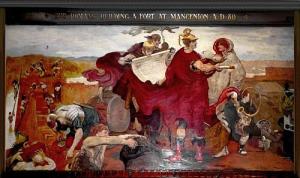
Romans Building a Fort at Mancenion, by Ford Madox Brown

Romans Building a Fort at Mancenion, by Ford Madox Brown

I’m very happy today to be guest posting at my friend Lisa Ahn’s beautiful blog, Tales of Quirk and Wonder. I’m discussing my world-building techniques for her Be Inspired series. Lisa and I kept crossing paths as commenters on our favorite writing blogs, including Writer Unboxed. I always found her comments insightful. At about the same time she began gracing my blog with wit and wisdom, I started following her blog, and immediately wondered why it had taken me so long. Her posts are not just witty and wise, they are gorgeously written. Her Wing-Feather Fables are moving and thought-provoking. Do yourself a favor while you’re over there, and dig back into the gems in her archives. You will not be disappointed! So what are you waiting for? Head on over!