A Sword By Any Other Name (…Would Still Just Be a Hunk of Sharpened Steel)

The Grande Ludovisi Sarcophagus – Depicting battle between Roman soldiers and Goth warriors.

“Every writer making a secondary world wishes in some measure to be a real maker, or hopes that he is drawing on reality: hopes that the peculiar quality of this secondary world (if not all the details) are derived from Reality, or are flowing into it.” ~J.R.R. Tolkien

Names—I haz ‘em: Lots of ‘em. My trilogy is based on the world of the epic culture clash between the Germanic tribe of the Goths and the ancient Roman Empire. Tom Shippey, Tolkien’s biographer, makes a case in J.R.R. Tolkien: Author of the Century, that for Tolkien everything started with the names. I took him to heart. One of the first things I did, before I wrote a single line of prose, was to come up with the names.

I just found my notes, dated January ’04 (I started outlining the story in November of ’03). I made lists of Gothic, Old Norse, Greek, and Latin words I thought were pertinent to the story and the world I wanted to create. I invented names not only for characters, but for nations, tribes, cities, seas, provinces, empires (yes, plural), oaths, clans, religious elements and ceremonies. I have characters with invented names as well as invented titles, and even invented nicknames. I even named a few swords (are you scared yet?). Heck, I even named the horses; over a dozen of them (now you’re scared, right?).  

“Names, especially names which are not strictly necessary, weight a narrative with the suggestion of reality.” ~Tom Shippey  

Namey-Namer: So did I do this just to emulate my literary hero? Just to be clever? Well, maybe those were a tiny part of it. But it turned out to be a very immersive exercise. In some cases, I’m not sure if I created the name to fit the character or the character emerged from the name. For example, my heroine’s name is Ainsela. She is the daughter of a warrior queen, and her birth was associated with the coming of a prophesied upheaval for her people. In the ancient Gothic language, áin is one, but áina is a ‘particular’ one—it denotes a certain or special singularity. Sela is a Greek moon goddess, but in Gothic a silda is a wonder or a marvel. Ainsela’s tribe’s patron goddess is a Teutonic moon goddess, Horsella, who is also the patron of untamed nature and all things wild. Hence, Ainsela is ‘the special one, a marvel, born of untamed nature.’

Yes, I did something like this for every one of my names. Not all of them were quite this elaborate, but they all have meaning. Some I just had fun with, for example the names of two of the Roman antagonists. Malvius is rooted in the Latin malevelle: of evil intent. And Turgian is from the Latin turgere: to swell (as in his head, with pride).

Submariner: In the pursuit of creating my own distinct world, and in the interests of relating the story without the encumbrance of historical facts, I even changed the names of all ‘real’ places and peoples. I made the Romans into Tiberians, the Goths into the Gottari, and so on. I explain why in a bit more depth on the homepage of my website in a post called The Origin of Epic, but to summarize, I did it to gain a bit of distance from the readers’ preconceptions. I was hoping to accomodate total submersion in my world, to take readers on a voyage without having them bring their baggage onboard the sub. As Tolkien says above, I was hoping not just to draw on reality, but in the creation of a peculiar quality derived from Reality, and that this Reality would then flow into my world. I wanted the reader to lose themselves not in historical detail, but in story. I know there will be those of you who feel otherwise, but I believe that by suspending disbelief through world-building, the best historical fantasy actually puts the spotlight on story, thereby enhancing the emotional experience.

It can get a bit complicated, but so can actual history. In the interest of simplifying, I made up a glossary doc. In the beginning it was just a reference for me. It has over 150 entries. I ended up rewriting it in the voice of the trilogy, including a pronunciation key for each entry, and I offer it out to beta readers. I’ve had several say they enjoyed having it, a few saying it was a necessity, and one saying it intimidated her so much she never read the book. But most have said they hardly gave it a glance.

Literary Trip, or Trip-up? I know what some (if not most or all) of you are thinking. Something like: Are you nuts? Why would you trip up the reader? Why make it any harder for folks to get into your story? Why add something that will make it more difficult to get published? The names don’t have anything to do with the story, right?

To answer those questions, in order: Perhaps (by whose definition?); It’s not my intention; I hope it doesn’t, and that for certain readers it’ll aid in their submersion into story; Because being published wasn’t on my mind when I started; And that last one is a bit complicated, and perhaps is my point here (in case it’s not evident). For me, story emerges in part from world-building, and world-building emerges from names. So for me, the names have quite a bit to do with the story that emerged (I’m still a pantser, after all).

I understand that a lot of the ‘tripping up’ of readers by names can be avoided through their judicious introduction, through their being woven into the fabric of story deftly, and I’m working on it. But I am pretty darn fond of them, and couldn’t be easily convinced to change too many of them. I mean, there was a time when names like Frodo and Gandalf, Hogwarts and Dumbledore all sounded bizarre, but can you imagine any other name for any of those?

Back to those hunks of steel: The two named swords in my trilogy (Nahtsrein and Bairtah-Urrin for those who are interested—Ruler of the Night and Bringer of Light, respectively) are not magical. But they are more than mere weapons. They are emblematic of the leadership of the two ruling clans of the Gottari. They are just symbols, analogies for power—their importance placed upon them by the Gottari people. And isn’t that what story really boils down to? Stories are symbolic analogies for life.

So what’s in a name? Quite a bit… In my book, anyway.

What about you? Do you think I’m nuts? (On second thought, don’t answer that.) Do names trip you up? Do you think this is all just geek-speak, reminding you why you don’t read historical fantasy? Or do you feel names can enhance the story? Or do they make no difference, as long as the story’s good?

The Way I Like My Rejections – Guest Post

I am so excited to welcome my friend Lara Schiffbauer for my first-ever guest post here on Seeking the Inner Ancient. It’s so appropriate, as Lara and I have a growing history of shared firsts. She was this blog’s first-ever commenter. Then she conducted an interview of this humble writer for her wonderful blog, Motivation for Creation–a first for both interviewer and subject.

Lara  is a talented writer I first met via Writer Unboxed. She and I bonded over our mutual love of Star Wars, and we have since been sharing the road toward publication together, which leads me to her topic for the day. It’s one I’m all too familiar with, and I couldn’t be more delighted by her views and advice on a subject we, as writers, all face.

Take it away, Lara:

This summer I entered the dubious country of Queryland.  I finished my manuscript on May 30th, and crossed the threshold into the world of query letters, synopses and rejections, oh my!

Queryland isn’t exactly a warm, fuzzy place.  Nor is it totally unknown to me.  I started submitting short stories about two years ago, and amassed quite a few rejections before I got some acceptances.  I’ve been querying my novel for a month, and now have four or five rejections under my belt.

Over time, I’ve realized certain rejections are preferable to me, and certain rejections aren’t.  I also realized I’m only at the start of Rejection Trail for my novel, and I better come up with a method to handle all the stress without becoming suicidal (joking!)

Three Ways I Like My Rejections

Quick – The first rejection I ever got, I received less than twenty-four hours after I submitted my story, Bear Hug.  I later submitted to an audio short story book publication which took eight months to reject it .  I learned that quick is better.  A quick rejection allows me to move on, and hopefully get the story to a person who thinks it’s as cool as I do.  The only downside is that you can rack up the rejections faster, too!

Friendly –This is where I like the magazine rejections better.  I don’t know if they had any less submissions than the agents I’ve sent my query to, but three of the rejections for Bear Hug wrote back really nice, encouraging (albeit short) comments.  It was like using a doe-skin glove to slap my face rather than a chain mail gauntlet.

 Do No Harm – At the very least, I prefer my rejections in the form of a form letter.  I know that sounds odd, but the alternative can be evil.  I’ve read stories of scathing rejections.  That kind of nonsense is cruel and unhelpful.

Three Ways I Don’t Like My Rejections

Ganging Up – It doesn’t matter if I’ve sent queries/submissions out months apart, they will inevitably end up back in my e-mail box on the same day, or insanely close to each other.  This has happened frequently enough that last week when I got one rejection on Tuesday, I asked my husband if he wanted to take bets on which day the second would come in.  I was surprised it waited until Thursday.

Well-intentioned Mean Stuff – I have a friend who received a rejection from an agent who, after telling my friend what she liked about the story, told her to “bone up on your grammar.”  My friend does not have a grammar problem.  I believe the agent was trying to be helpful, but it didn’t end up helpful at all.  The upside?  If nothing else, the whole interaction let my friend know that she didn’t want to work with that agent, anyway.

Bad Timing – No, there is no good time to receive a rejection, but there are definitely times that are worse than others.  Remember that rejection I received on Thursday?  It came about ten minutes after I had just had a fabulous plotting session for my next novel.  I was flying high on creativity, and thinking “Yes! I can do this writing thing.”  I didn’t even get a full evening of feeling competent before the rejection came in.  Please, please, please, gentle rejection, give me a chance to feel some pleasure before the pain!

So What’s a Writer to Do?

I have identified three things I do that help me get my brain straightened around and remember a rejection is not the end of the world.  Really.

Exercise – There are two reasons why I think exercise helps.  The first is the endorphins, as well as the serotonin, dopamine and adrenaline, which are released and work together to make us feel happy and have happy, creative thoughts.  The other reason is because by exercising we can burn off the frustration we feel with each and every rejection.  Or, am I the only one who gets frustrated?

Chocolate (or some coma inducing junk food of your choice) –  I have long reacted to stress by eating.  When my date for the senior prom ditched me a week before the event, I ate a half-gallon of cherry nut ice cream in about a half-hour flat.  What I have learned over the years is moderation.  Put a limit on how much you can indulge yourself, and then go for it, if you want.  It’s called comfort food for a reason.  Sometimes we just need Hersheys to kiss the boo-boo on our writer egos.

Write, damn it! – There is no substitute.  Kurt Vonnegut says it best.  “You must stay drunk on writing so reality can’t bite you in the ass.”  That’s the version I live by.  Reality, and rejection, can be a nasty you-know-what.  Writing is a magic pill that takes me out of myself and my insecure feelings, and plops me into a place full of witches, angels and happy endings.  It’s a much more preferable place to be.

How do you handle rejections?

 Lara Schiffbauer is a writer, licensed clinical social worker, mother of two, wife of one, and a stubborn optimist.  She loves Star Wars, Lego people, science, everyday magic and to laugh.  You can find Lara on Twitter at @LASbauer, or at her blog,  Motivation for Creation.

Can I Entice You To Read On?

Openings have been on my mind of late. The topic seems to be haunting me, as such things tend to do once they are ingrained in your thoughts.

Everywhere I turn there are articles and discussions about the openings and opening lines of novels, and their importance. It came up on the Writer Unboxed facebook page yesterday, and I saw this article on the website io9 today. My friend and fellow fantasy writer D.D. Falvo has been featuring some of her favorite first lines as a regular Friday feature on her facebook page.

For those of you who haven’t been keeping score, I’ve recently begun a rewrite of book one of my historical fantasy trilogy. The goal of the rewrite is to capture readers and draw them in faster than any of my previous openings. Since I have three more completed books in the series that hinge on accomplishing this goal, I’ve been feeling just a wee bit of pressure to get it right.

But do I really care? I have written dozens of openings, most of them discarded, and evidently few of them have been worthy of further discussion. I’ve often thought the fuss over openings, and opening lines in particular, has been overblown. You see, I’m not one of those people who uses the opening page or pages as one of my criteria for selecting a book to read. These days, I usually find out about books online or through personal recommendations. On the rare occasions I make it to an actual bookstore anymore (the nearest one is over twenty miles away), I’m more of a back-cover-blurb and random-page-sampling kind of guy.

Well, perhaps just a little: I have to admit, when read the io9 list, and saw the opening to Jacqueline Carey’s Kushiel’s Dart, I perfectly recalled first reading it and being blown away. My wife and I were both reading in bed, and I actually read the opening few pages aloud to her. I was just elated by the baroque power of the first person voice (I’m pretty sure my wife was less thrilled by the interruption, but still…). I’d owned the book for several weeks. I picked it up after reading her Sundering duology, which had been a recommendation of George RR Martin. I wasn’t too enamored by the cover, and there the book sat, on my night stand. Until I ran out of books to read, picked it up and read the opening—and couldn’t put it down again.

So before writing this, I started perusing my shelves and my Kindle this morning. Several of my favorites have great openings and pretty enticing opening lines. A recent favorite, that knocked my socks off, was Robin LaFevers’ Grave Mercy:

“I bear a deep red stain that runs from my left shoulder down to my right hip, a trail left by the herbwitch’s poison that my mother used to try to expel me from her womb. That I survived, according to the herbwitch, is no miracle but a sign I have been sired by the god of death himself.”  

With that, I was not only sockless, I was all in. It’s one I could not put down (and highly recommend).

But I like wearing socks: They’re just so darn comforting and warm. Truth be told, I’m a bit of a sock weirdo, and rarely work without them on, even in summer. But I digress…

My point is, comfort is important to me. I am all for being wowed. But I don’t think it’s necessary. Intriguing is not the same as enticing. I don’t need clever to be drawn into story. I don’t need a hook to love a book (pun intended, if lame). All I really want is to experience the flavor of the voice. And to not be put-off by clunky prose or confused, of course. I want to feel a sense of impending conflict, but I also want to be comforted—for the first few paragraphs to assure me I’m going to enjoy reading what’s ahead.

Steven Pressfield is a master at this. Nothing too flashy, just solid storytelling from the first sentence—setting the tone for what’s to come. For example, the opening to Virtues of War:

“I have always been a soldier. I have known no other life. The calling of arms, I have followed from boyhood. I have never sought another.”

Or this one, from Last of the Amazons:

“When I was a girl, I had a nurse who was a tame Amazon. Of course such an expression is a misnomer, as one of that race may be domesticated no more than an eagle or a she-wolf.”

These are not showy; they are perfectly in line with the character’s voices. But more than that, they begin the story. Things move seamlessly forward from these lines. They also both happen to be first person, as is Kushiel’s Dart. I think third person is a bit trickier, but I still believe the same workmanlike virtue can be achieved.

So I was stuck for a bit. I wanted what Pressfield consistently achieves for my own opening. I thought my previous opening line was clever. In fact, I was going for clever—swinging for the fences. But, after a couple dozen rejections, I’m ready to call it a swing and a miss. Not that I think it was bad. It just didn’t matter. Nor did the rest of the opening. I even had a few rejecting agents say the words, “The writing is strong.” But those same agents followed that line with, “But I just wasn’t drawn into the story.” The opening just didn’t do its job.

So this week I stripped all the clever away and focused on story, lopping off about the first fifty pages of the old version with the idea of getting into conflict faster and much closer to the inciting incident. I thought about what mattered to my primary protagonist for the new opening; how he felt, what was his conflict in the moment. Then I tried to speak in the now well-practiced voice of the series (one could only hope by now, right?). I just put something down. Just to get my ass moving. I’m leaving it for now, but it’s not set in stone. Lord knows it very well may change. And it’s certainly not a showy hook, but it set my mood for the opening scene and the story to follow.

I suppose it all begs the question: I’m usually not much for sharing my work before it’s done. I don’t know that I consider it bad luck or anything. But  sharing out-of-context work never seems to me to do it justice. And it can also come off as a bit desperate, like I’m seeking validation or approval. Having said all that, I’m sure this post has a few of you wondering what I came up with. And, since its only a few lines that will likely change anyway, I’ll bend my rule and share my new opening paragraph with you. Big whoop, right? Anyway, here it is:

“Everyone knew he should be riding to war, just as everyone knew his mother was the reason he wasn’t. After all, he was the Wulthus clan heir, the rightful next bearer of the futhark sword. But she had seen to it that he was not among the departing hosts. Thaedan loved his mother, but at the moment he hated her for it.”

 As I mentioned, the focus is on Thaedan’s conflict in the moment before the oncoming action sequence, written in the third person voice of the series. I’m not sure I love it, but I do feel it achieves ‘workmanlike’ status. Good enough to move forward with the work. In the coming weeks, I’ll have to decide if I feel it’s good enough to entice readers to read on.

What about you? Are you wowed by showy hooks? Is simply starting the story enough for you? How do you feel about socks? Or would anyone else care to share?

Labels: You Only Get Three

Hot Under The Collar: This past Wednesday was Independence Day in the U.S. For the resort area I live in, this is a high holiday—the highest day of the high season. Urbanites and suburbanites from nearby Chicago flock to the area to sun themselves, light off dangerous fireworks, and generally eat, drink and make merry. It’s like Christmas in July for our area business people.

I’ve shared quite a bit about the background of my writing journey in the past, most recently in the fun-tastic interview conducted by my friend Lara Schiffbauer for Motivation for Creation. But all you need to know for this post is that I started writing nine years ago, I shared that I was writing with very few others, and that I finished a draft of my epic fantasy trilogy in June of ’09. I have long struggled with publicly embracing my writer status. Since ’09, through beta readers and my online activity, most who know me have come to know of my writing life.

Which leads me to why I get uncomfortable on the Fourth of July. We have a neighborhood parade culminating in a party every year. Neighbors, friends, my wife’s clients, friends of friends, all come. It’s a pretty big deal. The kids decorate their bikes, dogs wear flag bandanas; we’ve had fire trucks, ponies, convertibles with waving Forest Springs queens, floats, etcetera. Like Christmas, it’s a time of the year when I am confronted with seeing quite a few folks I only see once or twice a year. And I’ve grown to dislike it. 

So, What Do You Do?  It’s an unavoidable question. Behind the weather, asking an acquaintance how they occupy themselves is one of the oldest and simplest forms of initiating social small talk. In the earliest days of people finding out you are a writer, you get a variety of reactions: eye rolls, feigned interest, flight, questions about whether you want it made into a movie, questions about what you think of the most recent hot book (in case you’ve been living under a rock, it’s currently 50 Shades of Gray), and so on. I was just beginning to get used to this variety, although it took me a while to openly admit I was writing epic fantasy (people immediately go to dragons and hobbits when they hear the two words used together). Then I finally crafted a quick summary of my work that most find acceptable if not interesting.

But time marches on, and as I said, most now know of my writing. So what’s the problem, right? Well, it’s sort of hard to describe, but I have a feeling many of you writerly types out there will get it. So please bear with me while I set this up.

You Only Get Three Things: A very good friend of mine was my first beta-reader outside of family. After he finished the trilogy, we spent a whole day discussing the books. It was wonderful. He was one of the first to make me realize this writing thing was serious shit—like my life’s calling. During that discussion, I was bemoaning the aforementioned reactions to telling people socially (eye rolls, et al), and he said, “you’ve got to make it one of your three things.” I raised my brows and made one of those inquiring Scooby Doo noises.

My friend went on to explain his theory about how your social image is a reflection of you viewed through the prism of three, and only three, labels—if you’re lucky. Some folks only get one or two. To demonstrate, he gave me his and mine. His were: 1) Gay with Longtime Partner (always a powerhouse, as far as labels go); 2) Stewardess (his own name for his paying gig of airline attendant); and 3) Jewelry Guy (he’s actually a talented jewelry designer, but since his family is in the jewelry biz, he only gets ‘guy,’ and not ‘designer’).

He said mine at the time were: 1) Mo’s Husband (in our social circle my wife has, and always will have, the better and more visible image); 2) Carpenter (I have a pretty good rep here); and 3) Lumber Guy (even though we previously ran a business that did more than just sell lumber, this is what sticks—this guy knows about, and can procure, lumber). My friend insisted, beyond the closest circle of friends and family, these three are all the labels society is willing to allocate. Trying to add a fourth is impossible. To add new one, an old one has to go.

So the idea is to use what little influence you have on your own labels to make at least one of your three into what really describes your heart’s desire. I started telling people I was a WRITER, dammit–actively seeking to make it one of my three (hoping Lumber Guy would drop away, which it pretty much has). And I actually did it! Over time, and with some effort, I am now known as a writer.  In most of my circles, it’s pretty much become one of my three (if not number one). Again, you might ask: What’s the problem?

The Well-Meaning Inquisition: Let’s get back to the Fourth of July. Here came the folks I only see once or twice a year. They see me, sort through the labels they recall, find the one they feel is most interesting (or meaningful to me if not interesting to them), and say, “So, how’s the book coming?”

Don’t think I don’t appreciate the effort. It really is well-intentioned, and I’m glad it’s become the most prominent of my three. But am I really supposed to tell them I just finished a third revision of my book three, and that I’m excited by some of the rejection feedback I’ve recently gotten on book one, and am gearing up for yet another rewrite of the opening? Or that I have been getting some pretty good feedback from betas on my fourth manuscript, which is a prequel to the trilogy they’re probably uninterested in?

They want me to tell them the book is done, and soon to be published! And, since I finished a draft in June of ’09, they’ve heard me talk about how I’m still plugging away for four Fourths now (you don’t often get to say, “for four Fourths,” and have it make sense, btw). I understand they don’t really want details, and anything I tell them culminates in “still not published.” Then they give me sad eyes. Or phrases like, “Well, hang in there,” or “At least you still have carpentry, right?”

What Do They Know? That’s just it. They know one, two, or three of my labels. It’s very superficial, but it’s not their fault. I only know one, two, or three of their labels, too. They can’t know that my writing journey has been the greatest of my life, and that the past year has been one of my proudest. They don’t know how close the work is finally getting to being ready, how I now have a column in the Writer Unboxed newsletter, or how prestigious WU is. They don’t know I’ve met so many wonderful friends in the writing community, how I feel so appreciated and supported. They can’t know that my gut is finally telling me this trilogy might really find an appreciative audience—that it might not only be enjoyed by readers, but will affect some of them, leaving them moved and thinking big thoughts after reading the final page.

And since I can’t find a way to easily explain all of this in the allotted time—at least not without their eyes glazing over—when they ask, “So, how’s the book coming?” my answer is a smile and a simple, “It’s coming along. Thanks for asking!” Then I ask them if I can refill their drink or fetch them another beer, and I get the hell outta there.

How about you guys? What are your three things? Is WRITER one of them? How do you handle, “So, how’s the book coming?”

Originality Isn’t Everything

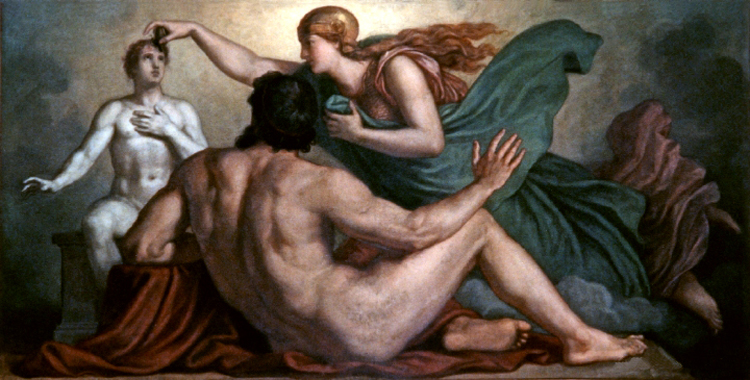
Prometheus watches Athena endow his creation with reason, by Christian Griepenkerl (1877)

This post was inspired by the review in this morning’s Chicago Tribune for the movie Prometheus. The title is a quote from the article, quoting an unknown source. The reviewer (Michael Phillips) gave the film three out of four stars, in spite of its derivative nature. He called it ‘elegant’ and ‘stately’ and said ‘the best aspects of the tale are atmospheric.’ Phillips worries that such factors will be lost on the targeted teen audience for summer blockbusters, and he’s probably right. Don’t worry, I’m not going to bemoan the lack of patience of today’s audiences for atmospherics. I already did that a few weeks ago, here. This time I want to talk about derivation. I promise not to bemoan those who are too quick to cite it. Well, not too awfully much.

“I didn’t steal the story from anybody. I stole it from everybody.”

~Dan O’Bannon, writer of the movie Alien

At my signal, unleash Hell: I perk up for everything Ridley Scott does, primarily because my all-time favorite movie is Gladiator—also derivative, in so many ways. And yet I freely stole from it in writing my trilogy. The movie came out in 2000 and it was undeniably a great influence on my decision to set my work (begun in ’03) in the late period of imperial Rome. There were other factors, of course, and as with almost everything in my work, I look at imperial Rome in an inverted way, from the eyes of those Rome considered barbarians. But hindsight reveals that I shamelessly stole elements. In Gladiator, Maximus is a wildly successful imperial general, who rides with his own equine ala. He is not Roman by blood, but from one of the provinces (Iberia, remember his nickname was Spaniard). He is beloved by an emperor and plotted against by those who see his influence on that emperor as a danger to their own quest for power. Yep, I got one of those. Again, there are differences, but the influence cannot be denied.  Are you not entertained?!

Viewpoints from North and South: I’ve been a John Jakes fan since a young age, and North and South and the Kent Family Chronicles are old favorites. Also read Irwin Shaw’s Rich Man, Poor Man early on. So does it surprise you that I have brothers, one raised inside the fold of imperial power and the other an expatriate, ending up on two sides of a conflict? I thought not. I love exploring issues and conflicts from various perspectives. I had a great time inserting POV characters into situations where they are the outsider seeing the other side in a new light, and sprinkled those situations liberally throughout my work. I’m hoping this influence, learned in my earliest reading, adds richness to my story that readers will enjoy.

Wherefore Art Thou, Lover? Another major element of my story I suppose some might consider derivative is my romance. Yes-siree Bob, I have star-crossed lovers. They long for one another, and yet are kept apart by their duties and societal/clan mores. Of course this goes back beyond Shakespeare, and one could argue it’s a component, in at least some small way, to just about every romance story ever written. My biggest influence in this realm has to be The Far Pavilions, by M.M. Kaye. This was one of those books that kept me up into the wee hours as a teen. I’m man enough to admit it: I was rooting for romance. Oh, how I wanted Ash and Juli to find a way to be more than the friends they were as children. And it was just so damn impossible. And yet… Well, no spoilers here, for those who’ve never read it.

From the Greeks to a galaxy far, far away: Honestly, I didn’t set out to steal from my favorite stories. Most of these influences occurred to me after I finished the first draft of the trilogy. I merely set out to write the kind of story I loved to read, so of course my favorite stories showed up in there. And I could go on and on, finding stories I love and how they’ve influenced my work. I’ve already written a post about how I have warrior chicks, and the influences there, from Jordanes to Steven Pressfield. One of the biggest elements of all is the overriding conflict of my world, wherein a republic has become an empire, and the components of its bureaucracy become a corrupting force willing to exploit fringe groups for profit and power, leading to insurrection. If that’s not familiar to you, perhaps you’ve kept your head buried in the Tatooine sand for the last 35 years.

“There are no new ideas. There are only new ways of making them felt.”
~Audre Lorde

Oldest Story in The Book

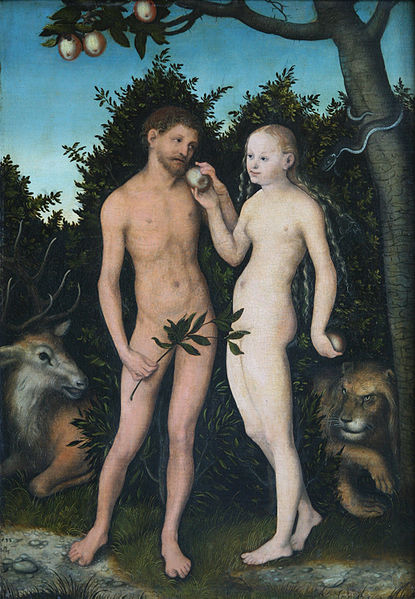
A good ribbing: In an argument over the movie Avatar, I once challenged a friend of mine to name a story that was totally unique. He pondered for a time before spitting out, “The Truman Show.” That’s an easy one and one of the oldest. A lone overseer creates an entire world and ends up falling in love with the subject he places in it, only to be thwarted in keeping him under his thumb by inadvertently allowing a woman into the picture. Duh. It’s Genesis.

How about you? Writers, what stories have influenced your work? Readers, are you bothered by what some call derivatives in your stories? Do you dare to take the challenge, either to claim your story is totally unique or even to name one that has none? I’m interested.

What Building My House Taught Me About Writing

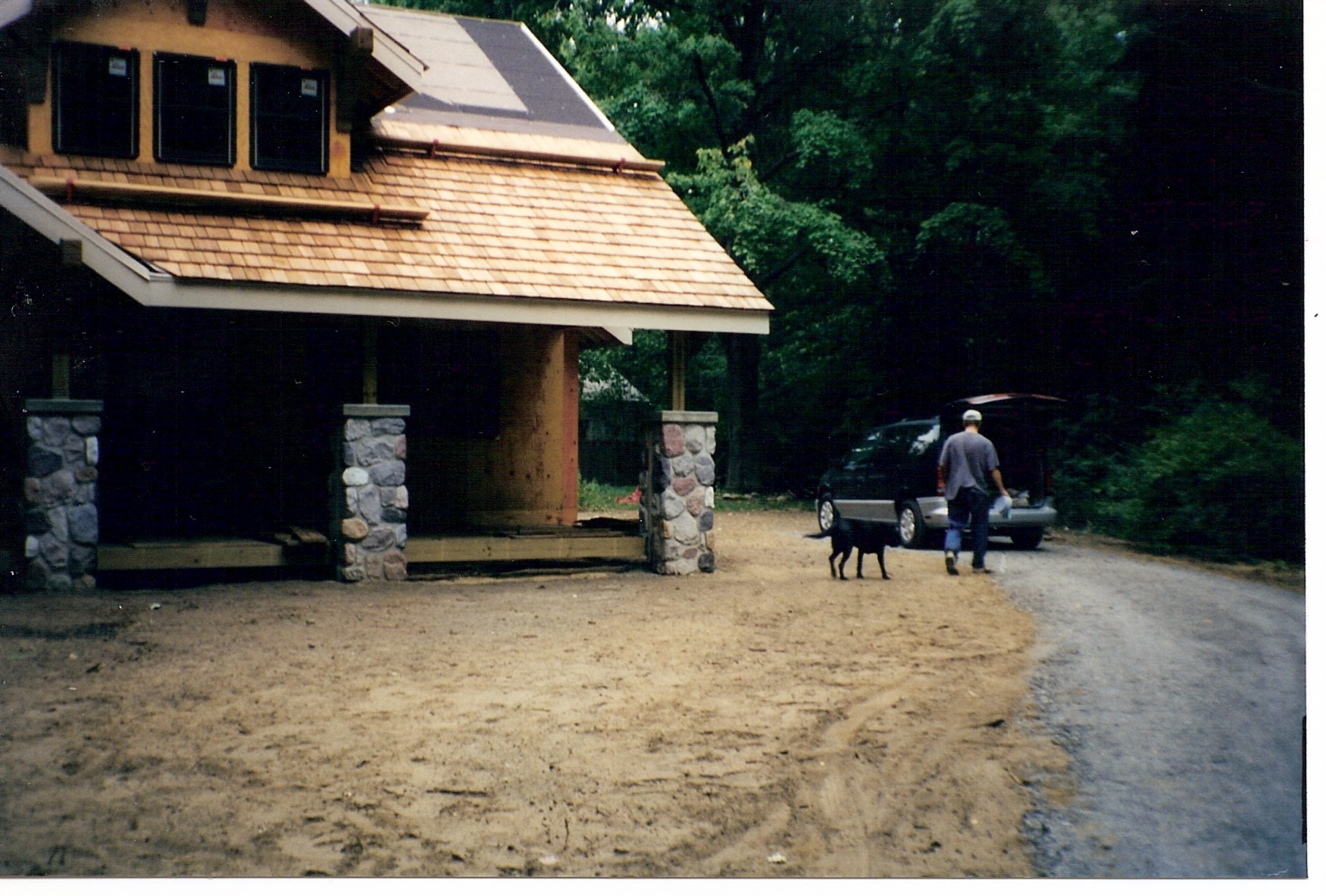
Front porchIt’s been twelve years since my wife and I completed the building of our cottage in the woods, and it wasn’t long after finishing that I began writing. In looking at some of the pictures of the process, I can see our wide-eyed innocence in the early shots, and the knowing weariness of experience in the pictures toward the end of the process. I still love my house. And, although the trilogy won’t really be ‘done’ until it’s published, I still love my story and characters, too. There are lessons from house-building that helped, and will continue to help, with my writing.

Know where your heart longs to dwell: Building your own house is a long-term commitment. You’re going to spend a lot of time there, so it ought to be a place you love. The same goes for writing. You’re going to spend long hours in the setting and with the characters. It helps if they are dear to you. For me, in both cases, I knew my heart would be most at peace in a historical setting. I’ve always loved the craftsmanship, human scale, and form-follows-function aspects of Arts and Crafts architecture, and I’m fortunate that my wife feels the same. We spent years looking at style and plan books and magazines, and studying the aspects of existing houses we loved before drawing the plans for our house. In the case of my trilogy, my heart longed to dwell in an epic tale, set in an ancient world I can only experience though the written word. I spent years reading the genre before selecting the niche that would house my story.Solid framing

Start with a solid foundation and quality materials: In the case of the house, we didn’t cut corners, and went with a full masonry foundation, hearth and chimney. Since we were in the forest products business, top quality lumber went into solid framing techniques and authentic wood finishes and details. I know the house has a firm footing and good bones. The same goes for writing. I did several years worth of research, in my case on the Germanic tribes and the ancient Roman Empire. I had most of my character and place names picked out, and those names have meaning for me. I wrote out a backstory and an outline. Don’t get me wrong, there were surprises along the way, both in building the house and in writing the trilogy. I consider myself a pantser in writing, and now that I think about it, I’m also a bit of a pantser when it comes to carpentry. And many of those serendipitous surprises made both projects better. But you want to have a solid structure in place before you start the process of fleshing it out.

It’s the details that add the richness: There are certain elements I love about the A&C style that evoke the feelings I sought in our house. The glowing warmth of lacquered Douglas fir paneling, the impression of solidity offered by exposed beams and brackets, the reminiscence of subway tiling and bead-board, among many others. But you can go too far as well. We had to pick and chose the elements that complimented one another to create a unique whole. The same rules applied to story elements and research details for my writing. It took me a long time to understand that not every historically accurate detail can be added. A few well-chosen tidbits enhance the flavor. Likewise, too many subplots can detract from the primary thrust of the story. But I still prefer solid wood paneled wainscoting with matching crown, base, and casing to an unadorned drywalled square of a room. All the elements of the architecture, along with a few well-chosen authentic period accessories, all go a long way to evoking feeling for those who visit, making them want to return again and again.

Take it day by day: Undertaking such a large project can be daunting at first. I particularly remember the feeling after the first day of hand-hammering our cedar shingles. My wife and I started the roof with neither of us having ever nailed a single wood shingle. It was July, and we guessed that with the long weekend for Independence Day thrown in, we might be able to complete it in a month of weekends. We laughed about that as we nailed the ridge shingles on in a light swirling snow (yep—November!). After that first day, we only had about three courses on one side of one portion of the house. But we kept at it, every chance we got, dawn till dusk. And now, twelve years later, without a single leak, who cares how long it took? And each stage was more of the same—daunting but, through steady effort, finally done. Writing is the same. Day by day, word by word, sentence by sentence, you get to a draft. Then, step by step, you revise and polish. Some days it feels like it’ll never end. But afterward, when I see my books in print, I’ll look back and it won’t matter how long it took.    

Leap of Faith: Both the house and the trilogy were projects that required not only a willingness to work hard, but a leap of faith just to begin. I had to just dive into both. Both projects make me wonder whether I would’ve undertaken them if I’d known what I was in for along the way. It’s been nine years since the inception of the trilogy, and the revisions continue. Building the house is one lesson among many. Slow and steady has served me well in life. I know I’ve built my trilogy with good bones and a solid foundation. I think I can make it into the kind of world and story certain readers will want to visit again and again.

What about you? Do you ever feel daunted by the process? Have you done something that required a leap of faith? Are you better for having done it?

Regarding Kickass Warrior Chicks

9780940_mI recently read a blog post on the topic of the proliferation of empowered warrior women by Jane Kindred, and I haven’t been able to get it off my mind since. I’ve come to respect her since reading her debut fantasy, The Fallen Queen, which I reviewed for my gig at ReaderUnboxed. In her post, Jane points out that making females as violent and physically adept as males does not empower them. Indeed, since it’s a fact that women are generally smaller and not as physically strong as males, the literary trend of making them so could be viewed as damaging. She points out that women could be – and should be – shown as equals in ways that don’t involve physical ass-kicking. Using their brains, for example–Duh, right? One of the post’s commenters advised fantasy writers to think long and hard about why they would want to portray women that way.

So I have been thinking. So much so that I needed to write about it, just to clear my head.

Got Warrior Chicks? For anyone reading this who hasn’t read my fiction: warrior chicks, I haz ’em. You might say they feature prominently, in all four of my finished manuscripts. Oh yeah, and they’re kickass, if I do say so myself.

I call my work historical fantasy, but it is probably closer to alternate history than fantasy. There is no system of magic. Some readers might glean that my Gottari are based on the Germanic tribe of the Goths, and their Tiberian foes will be quite recognizable as the ancient Romans. So the most fantastic thing about the books is my creation of the Skolani, and their insertion into this otherwise recognizable alt-historical world. The Skolani are an all female Teutonic warrior sect pledged to an alliance with the Gottari. More simply put, they are a tribe of kickass warrior chicks.

Where did the Skolani come from? I read a lot about the Amazons after reading (and loving) Steven Pressfield’s The Last of the Amazons. Much later, while researching the Goths for the books, I read a fifth century treatise by a Goth named Jordanes called The Origin and Deeds of the Goths. Jordanes lays the claim that the Amazons of Greek myth were actually the abandoned wives of the Goths, who had left their women on the northern coast of the Black Sea to conquer Persia and Egypt–a premise I found amusing as well as interesting. From there, I loosely based the tribe on an amalgam of several Amazon myths, the American Indians (particularly the Great Lakes tribes), and the Sarmatians (an ancient matriarchal nomadic warrior society of the Black Sea region, from which I took the name Skolani, which means ‘We fight to be free’). They live in a Kabitka, which is a cross between a nomadic horse-culture tent-camp and a woodlands American Indian village.

Skolani girls receive martial training from the time they can stand and hold a weapon, and ride from the day they can stay in a saddle unaided. The biggest and most athletic are chosen to receive blades, and aspire to be risen to the ranks of the Blade-Wielders, the most vaunted warriors in my world of Dania.

Just your everyday garden-variety asskickers. I didn’t want the Skolani to be super-humans, or invincible, or lesbians, or asexual, or man-haters, or secretly wanting/needing men. I wanted to them to be a collection of individuals. They are both good and bad, wise and foolish, strong and fallible. In other words, I endeavored to create interesting, multidimensional characters that readers–both male and female–would enjoy getting to know.

But why? So back to my point: why did I create the Skolani? Since reading Jane’s post I’ve pondered, looking at it from every angle–again. As I said, I thought long and hard about them from the inception. I can honestly say I did it because I wanted female characters who were on the same footing as the male characters. So, to Jane’s point, did they have to be kickass warriors to be on the same footing?

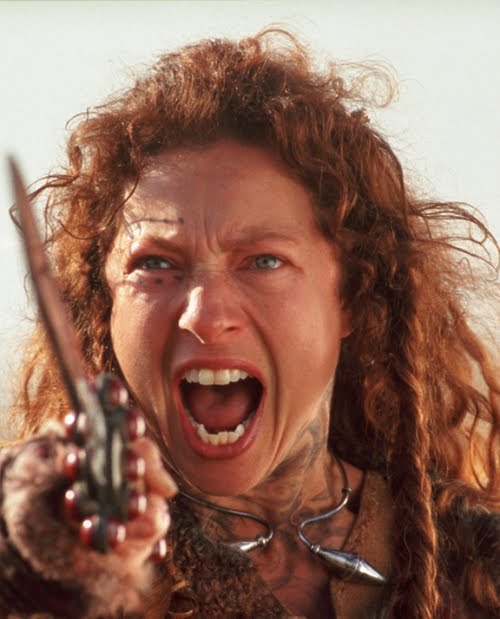
The answer I’ve arrived at is, yes. My alternate history world is a violent one. When I say on the same footing, I don’t mean simply being as smart or as strong. I wanted to totally eliminate the need to justify having my male characters perceive my female characters as total equals. Never once, in any of my work, does a Gottari male utter a misogynistic or chauvinistic phrase about or to a Skolani female. Never does anyone utter anything resembling, “Oh, that is such a typical female thing to say/do.”Boudica

Strong Females: With the addition of the Skolani, I hoped to create a genuine historically-correct atmosphere in which my male and female characters could approach one another with the same respectful consideration as two males would–to have the opportunity for males and females to appraise one another both inside and outside the realm of sexual attraction. I wanted my male and female characters to be friends, comrades, occasionally lovers, or even esteemed foes, all within the context of a believably historical setting. I still believe that maintaining this intersexual dynamic in my setting would’ve been difficult without my creation.

I believe my kickass warrior chicks make my story more plausible, not less.

My Inspiration: Anyone who knows me well and has read my work can see that there is a lot of my wife in there. And, although she is not a Blade-Wielder, she is the most capable person I’ve ever met. Our relationship sprang from a friendship, and is founded on mutual respect. She has saved me from myself more times than I care to enumerate here. I often refer to her as the other half of my brain. I would honestly be lost without her. Although none of the Skolani are specifically based on her, in a way they are all modeled after her.

So, in a way, it is her fault I write about kickass warrior chicks. In a very real way, the trilogy is a tribute to her. So thank you, my Anam Cara.

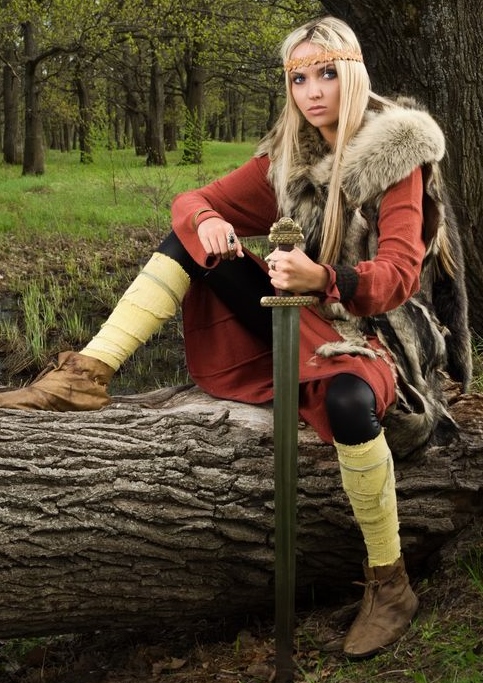
Image credit: <a href=’http://www.123rf.com/photo_9780940_viking-girl-warrior-with-sword-in-a-wood.html’>demian1975 / 123RF Stock Photo</a>